

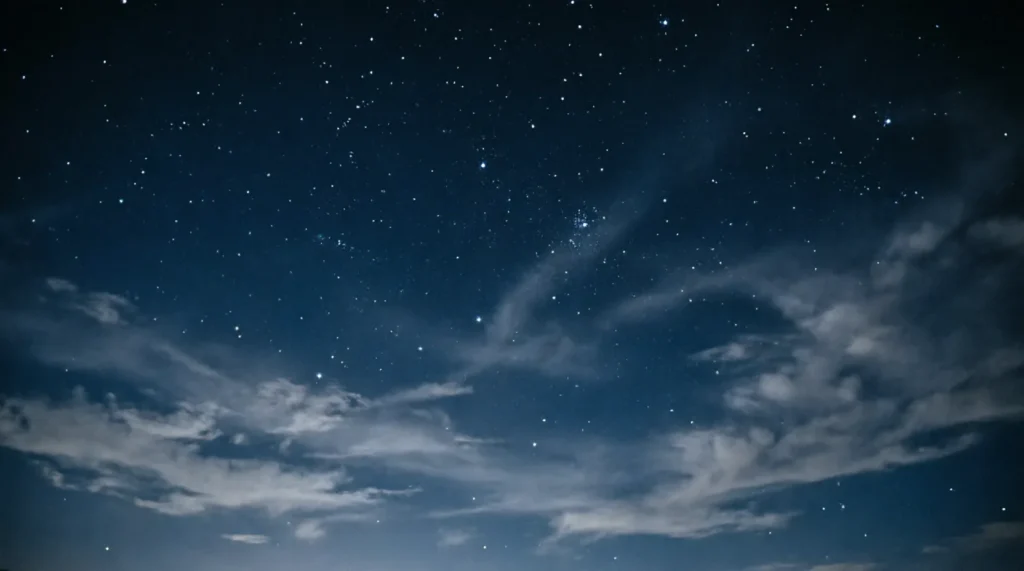
Finding the right simile to describe a dark night can transform a flat setting into a living, breathing atmosphere. Whether you are drafting a suspenseful thriller, a reflective poem, or a haunting college essay, the comparisons you choose dictate the emotional temperature of the scene. Below is a curated collection of night similes, complete with example sentences and tone notes, so you can drop them straight into your manuscript.
Ominous and Threatening Darkness
When your scene requires tension, the darkness should feel active and predatory. I always tell my students to avoid tired clichés like “as dark as pitch” or “as black as coal.” Those phrases have lost their sensory impact through overuse. Instead, reach for comparisons that evoke confinement, silence, or sudden danger.
- “as black as a sealed tomb” — “The forest stretched out as black as a sealed tomb.” (ominous, suffocating). Craft note: The hard ‘k’ sounds in ‘black’ and ‘sealed’ create a percussive, abrupt rhythm that mirrors a sudden chill.
- “like a predator holding its breath” — “The darkness settled over the cabin like a predator holding its breath.” (tense, watchful).
- “as impenetrable as an iron vault” — “The midnight sky was as impenetrable as an iron vault.” (heavy, inescapable).
- “like spilled ink swallowing the stars” — “Night crept across the moor like spilled ink swallowing the stars.” (active, consuming).
- “as hollow as a forgotten grave” — “The shadows in the hallway felt as hollow as a forgotten grave.” (eerie, desolate).
- “like a blindfold pulled tight” — “The evening arrived like a blindfold pulled tight.” (disorienting, abrupt).
- “as cold and absolute as a judge’s gavel” — “The dark descended, as cold and absolute as a judge’s gavel.” (final, unforgiving).
- “like a swarm of silent bats” — “The shadows gathered in the corners like a swarm of silent bats.” (unsettling, kinetic).
Peaceful and Enveloping Darkness
Not all darkness is scary. In memoirs or lyrical fiction, night often brings relief, rest, and intimacy. The version my students always reach for first in these moments involves soft textures and quiet movements. These comparisons should feel like an exhale after a long day.
- “like a heavy velvet curtain” — “Night fell over the valley like a heavy velvet curtain.” (smooth, enveloping). Craft note: The soft ‘v’ and ‘l’ consonants in ‘velvet’ mimic the quiet, frictionless drop of evening.
- “as comforting as a wool blanket” — “The dark wrapped around the house as comforting as a wool blanket.” (warm, secure).
- “like a deep, dreamless sleep” — “The countryside slipped into darkness like a deep, dreamless sleep.” (tranquil, restorative).
- “as soft as a moth’s wing” — “The twilight faded into night, as soft as a moth’s wing.” (gentle, delicate).
- “like a quiet lullaby” — “The shadows lengthened like a quiet lullaby.” (soothing, rhythmic).
- “as still as a held breath” — “The midnight air was as still as a held breath.” (calm, suspended).
- “like a cool compress on a fevered brow” — “The dark night arrived like a cool compress on a fevered brow.” (relieving, soothing).
- “as boundless as a quiet ocean” — “The darkness stretched out as boundless as a quiet ocean.” (vast, peaceful).
Vast and Infinite Darkness
Sometimes the night sky is not threatening or comforting, but simply massive. This is the darkness of deserts, open oceans, and high mountain peaks. To capture this, you must juxtapose the intimate with the cosmic, forcing the reader to look upward and feel small.
- “like an unlit ocean” — “The sky above the desert was like an unlit ocean.” (expansive, deep).
- “as endless as a forgotten memory” — “The night sky seemed as endless as a forgotten memory.” (melancholic, vast).
- “like a cavern with no ceiling” — “We looked up into a darkness like a cavern with no ceiling.” (awe-inspiring, dizzying). Craft note: Juxtaposing the intimate ‘cavern’ with the lack of a ‘ceiling’ creates a striking scale shift that grounds the infinite.
- “as deep as a well without a bottom” — “The shadows in the valley were as deep as a well without a bottom.” (profound, absorbing).
- “like the space between galaxies” — “The rural night felt like the space between galaxies.” (isolated, cosmic).
- “as wide as a held silence” — “The darkness was as wide as a held silence.” (expansive, auditory).
- “like a blank canvas before the first stroke” — “The evening sky hung like a blank canvas before the first stroke.” (potential, empty).
- “as ancient as the mountains themselves” — “The dark wrapped the peaks, as ancient as the mountains themselves.” (timeless, monumental).
Urban and Modern Night Darkness
City darkness operates differently than rural darkness. It is fractured by streetlights, neon signs, and the hum of traffic. When writing urban scenes, your similes should reflect concrete, machinery, and the specific isolation of being alone in a crowd.
- “like a power outage in a megacity” — “The alleyway went dark like a power outage in a megacity.” (abrupt, modern). Craft note: The specificity of ‘megacity’ immediately triggers a modern, cinematic sense of isolation.
- “as grimy as a subway tunnel” — “The night air felt as grimy as a subway tunnel.” (claustrophobic, gritty).
- “like a switched-off monitor” — “The sky above the skyscrapers was like a switched-off monitor.” (sterile, electronic).
- “as hollow as an abandoned parking garage” — “The streets were as hollow as an abandoned parking garage.” (echoing, desolate).
- “like a smudged charcoal sketch” — “The city night looked like a smudged charcoal sketch.” (blurry, atmospheric).
- “as sharp as broken glass” — “The shadows cut through the streetlight as sharp as broken glass.” (dangerous, jagged).
- “like a paused film reel” — “The darkness settled over the block like a paused film reel.” (suspended, cinematic).
- “as suffocating as a crowded train car” — “The humid night was as suffocating as a crowded train car.” (oppressive, urban).
Poetic and Mythic Darkness
For historical fiction, fantasy, or high literary prose, the night often carries a weight of history or magic. These comparisons draw on archetypes, nature, and the sublime. According to the literary definition of a simile, this figure of speech relies on explicit comparison words like ‘like’ or ‘as’ to bridge two unlike concepts, making the abstract weight of darkness suddenly tangible.
- “like a widow’s mourning veil” — “The night draped the moor like a widow’s mourning veil.” (sorrowful, elegant). Craft note: Personifying the night as a ‘widow’ adds immediate narrative weight and sorrow without a single extra adjective.
- “as old as the first story ever told” — “The darkness felt as old as the first story ever told.” (primordial, legendary).
- “like a raven’s outstretched wing” — “The shadows swept across the field like a raven’s outstretched wing.” (sweeping, ominous).
- “as silent as a forgotten god” — “The midnight woods were as silent as a forgotten god.” (reverent, eerie).
- “like a secret kept for centuries” — “The dark hugged the castle walls like a secret kept for centuries.” (mysterious, guarded).
- “as heavy as a crown of lead” — “The night pressed down, as heavy as a crown of lead.” (burdensome, regal).
- “like a phantom ship on a black sea” — “The house sat in the darkness like a phantom ship on a black sea.” (isolated, ghostly).
- “as profound as a monk’s vow of silence” — “The evening was as profound as a monk’s vow of silence.” (deep, spiritual).
How to write your own dark night simile
Crafting a fresh comparison is easier when you break it down into a repeatable process. When you describe a setting, your goal is not merely to list visual facts, but to evoke a sensory response that anchors the reader in the scene. Follow these three steps to build your own.
Step 1: Identify the core emotion. Decide what the darkness should make the reader feel. Is it safety? Dread? Awe? Loneliness? Write that emotion down as your guiding north star.
Step 2: Find a concrete, sensory noun. Brainstorm objects or experiences that naturally carry that emotion. If the emotion is dread, think of sealed boxes, holding breath, or deep water. Avoid abstract nouns like “sadness” or “fear.”
Step 3: Connect them with “like” or “as.” Fuse the emotion and the noun into a tight phrase. Test it aloud to check the rhythm.
Worked Example: Emotion: Isolation in a modern city. Concrete Noun: An empty theater after the show ends. Drafting: “The city night was like an empty theater after the show ends.” Refining for impact: “The urban darkness settled like an empty theater after the final curtain.”
Frequently Asked Questions
What makes a night simile effective? An effective simile connects the abstract concept of darkness to a concrete, sensory experience. It should do more than state that it is black; it should convey temperature, texture, sound, or emotional weight, allowing the reader to feel the scene rather than just visualize it.
Should I use “as black as coal” to describe a dark night? No. I strongly advise skipping “as black as coal” or “as dark as pitch.” These are exhausted clichés that have lost their sensory impact through centuries of overuse. Your readers will gloss right over them. Opt for specific, unexpected comparisons instead.
Can a simile to describe a dark night also include sound or temperature? Absolutely. The best similes often engage multiple senses. A darkness that is “as cold and absolute as a judge’s gavel” merges visual blackness with auditory finality and physical chill, creating a much richer atmospheric effect than visual description alone.
How many similes should I use in a single scene? Use them sparingly. One strong, well-placed simile per scene is usually enough to establish the mood. Stacking multiple similes together creates purple prose and dilutes the impact of each individual comparison. Let your strongest image do the heavy lifting.

Justin Brown is a seasoned literary analyst with over 15 years of experience in the field of linguistics and literary studies. Holding a master’s degree in English Literature from the University of Chicago, Justin has devoted much of his career to exploring the nuances of similes and other forms of figurative language. His passion for deciphering the layers of meaning in literary works was kindled during his undergraduate years, where he was intrigued by the power of metaphorical language. Justin frequently contributes to VividSimiles by crafting engaging articles that decode the application of similes in both classical and contemporary literature. His insightful analyses help readers grasp the beauty and complexity of figurative expressions, making literature more accessible to all. In addition to writing, Justin conducts workshops for aspiring writers, nurturing their abilities to use language vividly and effectively.