

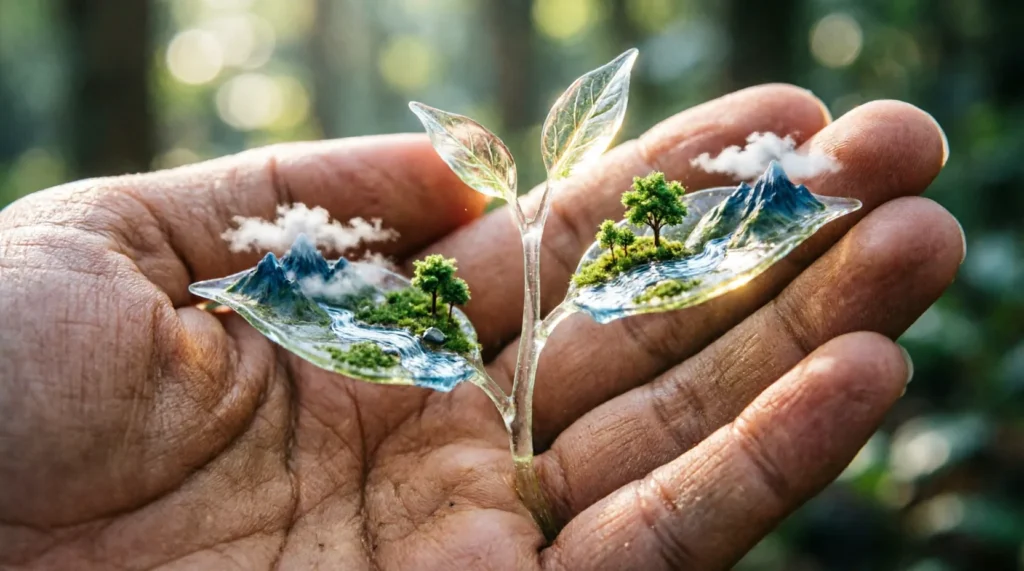
A metaphor for nature transfers the qualities of the natural world onto human experience, emotion, or abstract concepts to create immediate sensory understanding. The examples below are organized by emotional resonance and rhetorical function so you can select the precise comparison your sentence requires rather than settling for a generic platitude. Each entry includes a ready-to-use example sentence and a tone note to ensure the metaphor lands with the intended weight in creative nonfiction, poetry, or narrative prose.
What Is a Metaphor?
According to Metaphor, a metaphor is a figure of speech that directly refers to one thing by mentioning another for rhetorical effect, asserting an identity between two unlike domains without using “like” or “as.” This direct assertion distinguishes it from a simile, which makes a comparative link explicit; a metaphor claims the subject is the natural element, creating a stronger, more immersive cognitive fusion that asks the reader to accept the equivalence as truth within the context of the passage.
Metaphors for Nature as Nurturer and Sustainer
These metaphors frame the natural world as a benevolent, generative force, suitable for writing about healing, growth, maternal themes, or ecological gratitude. They work best when the surrounding text supports a tone of reverence or tenderness; using them in cynical or ironic contexts creates dissonance that usually reads as unintentional.
- Nature is a patient mother — “After years of concrete and noise, he returned to the valley where nature is a patient mother, waiting with open arms to absorb his exhaustion.” (tender, forgiving; the personification avoids sentimentality by emphasizing patience over mere affection).
- The forest is a cathedral — “She stepped beneath the redwoods and felt the hush of a congregation; the forest is a cathedral where light filters through stained glass of leaf and moss.” (reverent, sacred; this classic works because it maps architectural awe onto organic space, but avoid it if describing a damaged or logged landscape).
- Spring is a midwife — “The thaw did not arrive gently; spring is a midwife, pulling green life from the dark earth with urgent, bloody hands.” (visceral, active; subverts the passive “rebirth” cliché by acknowledging birth as labor, making it ideal for essays on resilience or climate adaptation).
- Rain is a benediction — “On the parched farm, the first storm was not weather but grace; rain is a benediction spoken in the language of roots.” (spiritual, grateful; the religious lexicon elevates precipitation beyond meteorology, fitting for memoirs about drought or faith).
- The soil is a ledger — “Every harvest records a debt; the soil is a ledger that remembers what we take and what we return.” (accountable, solemn; transforms dirt into moral record-keeping, effective in environmental advocacy or agricultural writing).
- Dawn is a promise kept — “After the longest night of grief, dawn is a promise kept, spilling gold across the horizon without condition.” (hopeful, reliable; avoids toxic positivity by framing hope as fidelity rather than forced optimism).
- The river is a lullaby — “Camping beside the current, she found sleep not in silence but in motion; the river is a lullaby sung in silt and stone.” (soothing, rhythmic; the auditory metaphor suits passages about insomnia, childhood memory, or water’s constancy).
Metaphors for Nature as Adversary and Teacher
Not all nature metaphors comfort; many convey danger, indifference, or harsh instruction. Use these when exploring trauma, survival, humility, or the sublime terror of wilderness. They resist romanticization and demand respect from both writer and reader.
- Winter is a strict tutor — “He learned discipline not from books but from frostbite; winter is a strict tutor whose lessons are written in numb fingers and shortened days.” (unyielding, formative; the educational frame prevents victimhood narratives while honoring hardship’s role in character development).
- The ocean is a creditor — “Coastal towns borrow beauty at high interest; the ocean is a creditor who always collects, sometimes in salt, sometimes in ruin.” (ominous, transactional; reframes coastal living as debt rather than idyll, powerful for climate journalism or disaster memoir).
- Wildfire is an editor — “The blaze consumed the underbrush with ruthless precision; wildfire is an editor cutting deadwood so new growth might breathe.” (destructive yet purposeful; controversial but ecologically accurate, useful in pieces about prescribed burns or post-traumatic renewal).
- Mountains are silent judges — “Standing at the pass, he felt his ambitions shrink; mountains are silent judges weighing human scale against geological time.” (humbling, timeless; avoids anthropomorphizing malice while conveying nature’s moral gravity through sheer presence).
- Storms are tantrums of atmosphere — “The hurricane made landfall not with strategy but with fury; storms are tantrums of atmosphere, indifferent to the cities below.” (chaotic, impersonal; the childlike metaphor underscores nature’s lack of intent, countering narratives of divine punishment).
- Desert is a mirror — “Stripped of distraction, he faced himself in the dunes; desert is a mirror reflecting only what cannot be hidden.” (austere, revealing; the emptiness becomes psychological exposure, ideal for spiritual autobiography or minimalist fiction).
- Frost is a scalpel — “The cold did not merely bite; frost is a scalpel excising weakness from the orchard, leaving only what can endure.” (precise, surgical; replaces vague “killing cold” with clinical intentionality, strengthening agricultural or medical-nature crossover writing).
Metaphors for Nature as Cyclical Process
These comparisons emphasize recurrence, transformation, and temporal patterns rather than static states. They suit reflections on aging, history, ecology, or any theme where linearity fails. According to Nature, the material world operates through interconnected physical processes, and these metaphors honor that dynamism by focusing on verbs and transitions over nouns.
- Seasons are a breathing rhythm — “The land does not progress; seasons are a breathing rhythm, inhaling bloom and exhaling decay in eternal measure.” (meditative, biological; respiration implies necessity over choice, grounding cyclical thinking in physiology).
- Tides are memory returning — “Each wave carries fragments of yesterday’s shore; tides are memory returning, never identical but always recognizable.” (nostalgic, fluid; links hydrology to cognition, effective for diaspora writing or intergenerational trauma narratives).
- Decay is compost in waiting — “The fallen log was not an end but an incubator; decay is compost in waiting, transforming loss into future fertility.” (regenerative, pragmatic; rejects morbidity by foregrounding utility, essential in sustainability writing or elegiac poetry).
- Migration is a compass calibrated by instinct — “The geese flew south not by map but by blood; migration is a compass calibrated by instinct, older than any human navigation.” (innate, ancestral; contrasts technological knowledge with embodied wisdom, resonant in indigenous or eco-psychology contexts).
- Erosion is slow confession — “Cliffs reveal their layers only through surrender; erosion is slow confession, wearing down defenses grain by grain.” (vulnerable, gradual; geological process becomes emotional honesty, perfect for memoirs about aging or long-term relationships).
- Pollination is gossip among flowers — “Bees carried secrets from blossom to blossom; pollination is gossip among flowers, spreading genetic news in golden dust.” (playful, communal; animates botany without cutesiness, suitable for children’s literature or joyful nature essays).
- Succession is inheritance rewritten — “Pines gave way to oaks not by conquest but by succession; succession is inheritance rewritten, each generation amending the will of the land.” (legalistic, evolutionary; frames ecological change as testamentary revision, adding intellectual texture to conservation writing).
Metaphors for Nature as Inner Landscape
These bridge external environment and internal state, treating nature as psyche made visible. Use cautiously: they risk solipsism if not anchored in observed detail. The strongest versions maintain nature’s autonomy even as they reflect human feeling.
- Grief is fog — “It did not lift but thinned; grief is fog, obscuring landmarks until navigation becomes an act of faith.” (disorienting, pervasive; fog’s physical properties mirror cognitive impairment better than abstract “darkness”).
- Joy is sunlight through canopy — “Happiness arrived not as flood but as dappled warmth; joy is sunlight through canopy, fragmented and fleeting yet undeniably real.” (qualified, ephemeral; avoids saccharine totality by acknowledging joy’s partiality, honest for mental health writing).
- Anxiety is bramble — “Thoughts tangled without fruit; anxiety is bramble, snagging every attempt at forward motion with thorny persistence.” (entangling, unproductive; bramble’s uselessness captures anxiety’s futility better than storm or fire metaphors).
- Clarity is still water — “After weeks of mental churn, insight came as surface calm; clarity is still water, reflecting sky only when agitation ceases.” (contingent, earned; emphasizes passivity over effort, aligning with contemplative traditions).
- Resilience is deep root — “She bent but did not break; resilience is deep root, holding fast in soil no one sees.” (hidden, structural; shifts focus from visible endurance to invisible infrastructure, empowering for disability or chronic illness narratives).
- Creativity is mycelium — “Ideas connected underground before surfacing; creativity is mycelium, weaving networks in darkness long before the mushroom appears.” (collaborative, subterranean; challenges lone-genius myths, vital for artistic process essays or team innovation writing).
How to Write Your Own Nature Metaphor
Start by identifying the precise quality you need to convey—not just “nature,” but nature’s specific behavior in relation to your subject. Ask: What does this emotion or concept do physically? Then scan natural phenomena for matching actions, not just appearances. Finally, test the metaphor against reality: Does the natural element actually behave this way, or are you forcing a poetic lie?
For example, instead of “her anger was a volcano” (overused and geologically imprecise for most personal rage), try “her anger was banked coals, glowing low beneath ash, capable of reigniting with a single breath.” This version respects combustion physics while capturing suppressed fury’s latent heat. My students often reach for dramatic disasters first, but the most enduring metaphors emerge from attentive observation of ordinary natural processes—dew formation, seed dispersal, tidal pooling—that carry emotional truth without spectacle.
Frequently Asked Questions
How do I avoid clichéd nature metaphors? Audit your draft for phrases like “mother nature,” “force of nature,” or “calm before the storm.” Replace them with specific, observed phenomena tied to your unique context. If you’ve heard the phrase in advertising or greeting cards, retire it. Freshness comes from precision, not novelty for its own sake.
Can nature metaphors work in technical or scientific writing? Yes, when used to clarify complex systems for non-specialist audiences. Compare data flow to nutrient cycling or network redundancy to ecosystem diversity. Always signal the metaphor explicitly (“think of this as…”) and clarify where the analogy breaks down to prevent misinformation.
What’s the difference between a nature metaphor and personification? Personification grants human traits to nature (“the wind whispered”), while metaphor asserts identity between nature and another domain (“grief is fog”). Personification animates nature; metaphor uses nature to illuminate something else. Both are valid, but metaphor typically carries greater conceptual weight in analytical or reflective writing.
Why do some nature metaphors feel manipulative or sentimental? Sentimentality arises when the metaphor ignores nature’s indifference or complexity to serve human emotional needs. A metaphor feels manipulative when it demands a response rather than earning it through accurate observation. Ground your comparisons in ecological truth, and let readers draw their own feelings from the integrity of the image.

Brian Walker is an esteemed linguist with a Ph.D. in Language and Literature from Stanford University. Over the past 20 years, Brian has dedicated his research to understanding the impact of figurative language on communication and literature. His extensive body of work includes scholarly articles that have been published in numerous academic journals. Brian’s fascination with similes emerged during his doctoral studies, where he examined their role in enhancing rhetorical persuasion and emotional resonance. As a contributor to VividSimiles, he writes detailed analyses on the historical evolution of similes and their varied applications across different cultures and languages. Brian’s articles are known for their depth and clarity, bridging the gap between academic research and practical application. He is committed to enlightening readers about the intricacies of language and the beauty of well-crafted similes.