

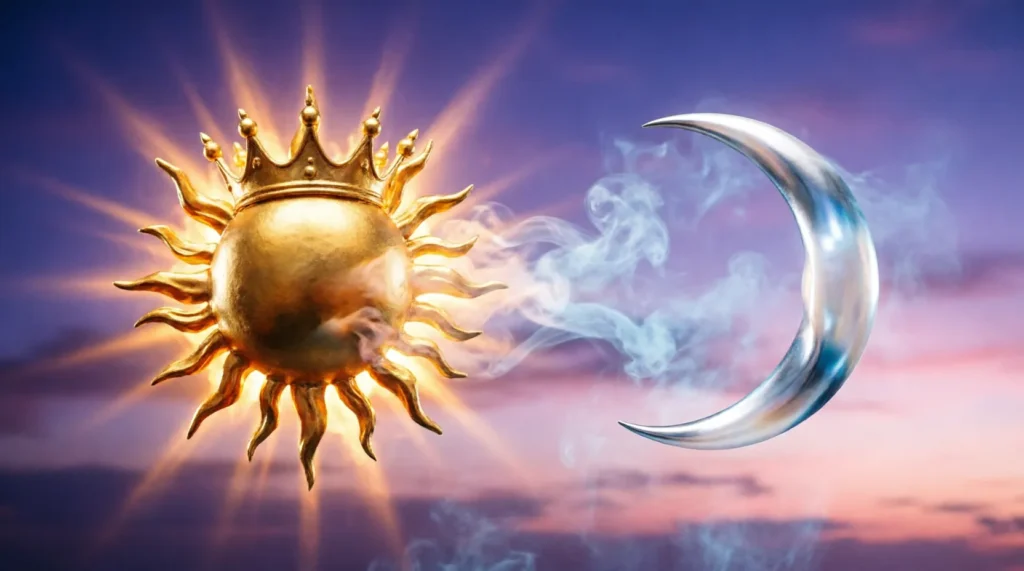
Similes are the bridge between the literal and the felt experience. When you describe the sun or moon using a simile, you aren’t just naming a celestial body; you are inviting the reader to feel its heat, its silence, or its eerie glow through a familiar comparison. The examples below are categorized by mood and intensity so you can drop them directly into your drafts, whether you are writing a quiet lyric poem or a high-stakes thriller scene.
Celestial Warmth: Similes for the Sun
The sun is often the engine of a scene’s energy. It can be nurturing, oppressive, or indifferent. My students often reach for “hot like fire,” but that is a tired cliché that tells us nothing new. Instead, look for comparisons that capture the quality of the light or the physical sensation of the heat on the skin.
- “like a gold coin pressed against the sky” — “The morning sun rose like a gold coin pressed against the sky.” (bright, valuable, crisp). This works because it gives the sun weight and tangible value, suggesting a rare, perfect morning.
- “as relentless as a hammer” — “The midday sun beat down as relentless as a hammer.” (oppressive, exhausting). Use this when the heat is an antagonist in your story, physically wearing down your character.
- “like spilled honey” — “Afternoon light poured through the windows like spilled honey.” (slow, sticky, sweet). This captures the viscosity of late-day light and the slow passage of time.
- “as bright as a welding torch” — “He squinted at the horizon, where the sun shone as bright as a welding torch.” (painful, industrial, harsh). Good for urban settings or scenes involving intense focus.
- “like a warm hand on my shoulder” — “The winter sun felt like a warm hand on my shoulder.” (comforting, gentle, reassuring). This personifies the sun as a protector, ideal for moments of relief.
- “as fierce as a lion’s gaze” — “The desert sun stared down as fierce as a lion’s gaze.” (predatory, intense, dangerous). This draws on the archetypal power of the lion to suggest the sun is watching and judging.
- “like a burst orange” — “The sunset exploded like a burst orange, spraying juice across the clouds.” (messy, vibrant, sudden). This is a sensory-rich simile that engages taste and sight simultaneously.
- “as steady as a heartbeat” — “The sun rose as steady as a heartbeat, marking the start of another day.” (reliable, rhythmic, life-giving). Use this to establish routine or the inevitability of time.
Night’s Quiet Eye: Similes for the Moon
The moon rarely shouts; it whispers. In my workshops, I encourage writers to treat the moon as a witness rather than a participant. It observes grief, romance, and crime with equal detachment. Avoid “like a cheese wheel” unless you are writing comedy. Aim for comparisons that evoke silence, coldness, or mystery.
- “like a pearl dropped in ink” — “The full moon hung in the sky like a pearl dropped in ink.” (precious, stark, contrasting). This highlights the visual contrast between the white moon and the black night, emphasizing purity amidst darkness.
- “as cold as a bone” — “The moonlight touched her face as cold as a bone.” (chilling, dead, unfeeling). Perfect for horror or melancholic scenes where the beauty of the moon feels threatening.
- “like a lantern left burning” — “The crescent moon swung above the trees like a lantern left burning.” (lonely, forgotten, guiding). This suggests human presence without showing people, creating a sense of abandonment or waiting.
- “as pale as a ghost’s breath” — “The winter moon looked as pale as a ghost’s breath.” (ethereal, faint, transient). This works well when the moon is barely visible, adding to a scene’s uncertainty.
- “like a silver coin in a fountain” — “The reflection of the moon shimmered on the lake like a silver coin in a fountain.” (distant, wished-upon, unreachable). This connects the moon to desire and things we cannot quite grasp.
- “as watchful as an owl” — “The moon followed us through the forest as watchful as an owl.” (silent, predatory, aware). This assigns agency to the moon, making it feel like a character that knows more than the protagonist.
- “like a crack in the dark” — “The sliver of moon appeared like a crack in the dark.” (fragile, revealing, sharp). This suggests that the night is a solid thing that has been broken, letting light leak through.
- “as smooth as polished stone” — “The moon’s surface looked as smooth as polished stone from here.” (distant, idealized, hard). This reflects how we romanticize distant objects, ignoring their rough reality.
Emotional Weather: Mood-Based Comparisons
Sometimes the sun and moon are not just objects in the sky but mirrors of internal states. When a character is grieving, the sun might feel intrusive. When they are in love, the moon might feel intimate. These similes tie the external world to internal emotion.
- “like an unwanted guest” — “The morning sun burst in like an unwanted guest.” (intrusive, jarring, rude). Use this for hangovers, depression, or mornings after bad news.
- “as shy as a first kiss” — “The moon peeked out from behind the clouds as shy as a first kiss.” (tentative, sweet, vulnerable). Ideal for early romance or moments of hesitation.
- “like a spotlight on a stage” — “The sun hit the pavement like a spotlight on a stage.” (exposing, dramatic, performative). This works when a character feels watched or forced to act.
- “as lonely as a single tear” — “The lone star near the moon looked as lonely as a single tear.” (sad, isolated, small). This amplifies the scale of loneliness by comparing it to something tiny yet significant.
- “like a promise kept” — “The sunrise arrived like a promise kept.” (reliable, hopeful, faithful). Use this after a long night of uncertainty, signaling safety.
- “as deceptive as a smile” — “The moonlight hid the shadows as deceptive as a smile.” (tricky, hiding danger, false comfort). Good for thrillers where things are not what they seem.
Elemental Forces: Power and Nature
When you want to emphasize the raw power of these celestial bodies, compare them to natural forces that cannot be controlled. This moves the description away from visual appearance and toward physical impact.
- “like a tidal wave of light” — “The dawn broke over the mountains like a tidal wave of light.” (overwhelming, unstoppable, massive). This captures the speed and force of sunrise.
- “as ancient as the rocks” — “The moon watched us as ancient as the rocks beneath our feet.” (timeless, indifferent, enduring). This reminds the reader of the deep time scale, making human problems seem small.
- “like a furnace door opening” — “The heat hit us like a furnace door opening.” (sudden, intense, industrial). This is more visceral than “hot like fire” because it implies a mechanical, unavoidable source.
- “as silent as snowfall” — “The moon moved across the sky as silent as snowfall.” (quiet, gentle, accumulating). This emphasizes the lack of sound in space and the gradual change of light.
- “like a judge’s gavel” — “The noon sun struck down like a judge’s gavel.” (final, authoritative, punishing). Use this when nature is delivering a verdict on a character’s actions.
- “as fragile as eggshell” — “The thin crescent moon looked as fragile as eggshell.” (delicate, breakable, temporary). This creates tension, suggesting the light could disappear at any moment.
How to Write Your Own Sun and Moon Simile
Creating a fresh simile is less about finding a “pretty” word and more about finding the right connection. Here is a simple three-step process I use with my students to move beyond clichés.
- Identify the specific trait. Don’t just say “the sun.” Is it blinding? Warm? Early? Pick one adjective. Let’s say “blinding.”
- Find a non-celestial object with that trait. What else is blinding? A camera flash? A diamond? A slap? Let’s choose “a camera flash.”
- Test the rhythm. Say it out loud. “The sun was like a camera flash.” It’s okay, but flat. Try adding action. “The sun erupted like a camera flash.” Better. Now add context. “The sun erupted from behind the cloud like a camera flash, freezing the bird in mid-air.”
Worked Example:
- Trait: The moon is faint and disappearing.
- Object: A dying ember.
- Draft: The moon faded like a dying ember.
- Polished: “The moon faded in the dawn light like a dying ember in cold ash.”
This method ensures your simile is grounded in sensory reality rather than abstract poetry.
Frequently Asked Questions
What is the difference between a simile and a metaphor for the sun? A simile uses “like” or “as” to compare the sun to something else (e.g., “the sun was like a coin”), while a metaphor states that the sun is that thing (e.g., “the sun was a gold coin”). Similes are often safer for beginners because they acknowledge the comparison is figurative, whereas metaphors require more confidence in the imagery. For a deeper understanding of how these figures of speech function, you can explore the general concept of Metaphor in literary theory.
Why should I avoid clichés like “sun like a ball”? Clichés are ineffective because the reader’s brain skips over them. They have been used so many times that they no longer create a mental image. “Sun like a ball” is technically accurate but emotionally empty. Readers want to feel the heat or see the color, not just recognize the shape. Always push for a comparison that adds new information about the mood or setting.
Can I use similes for the moon in sci-fi or fantasy settings? Absolutely. In fact, similes are crucial in speculative fiction to ground the unfamiliar. If your character is on a planet with two moons, comparing one to “a cracked eye” and the other to “a pearl” helps the reader visualize the alien sky using familiar earthly objects. The key is to ensure the comparison fits the technology level and culture of your world. For factual context on lunar characteristics that might inspire your descriptions, refer to the detailed entry on the Moon.
How many similes should I use in one paragraph? Less is more. One strong simile per paragraph is usually enough to anchor the image. If you use too many, the prose becomes cluttered and the reader loses track of the actual action. Think of similes as spice: a little enhances the flavor, but too much ruins the dish. Choose the one comparison that does the heaviest lifting for that specific scene.

Jennifer Martinez is a creative writer and educator with a deep love for similes and figurative language. With a degree in Creative Writing from New York University and over a decade of teaching experience in high schools, Jennifer has a unique ability to explain complex concepts in simple terms. Her journey into the world of figurative language began with her own writing, where she noticed how similes and metaphors could transform the mundane into the extraordinary. At VividSimiles, Jennifer shares her expertise by writing thought-provoking essays and guides on how similes enhance storytelling. Her content often focuses on helping writers of all levels hone their style by incorporating figurative language effectively. In her spare time, Jennifer enjoys reading poetry and experimenting with new forms of expression in her own work.