

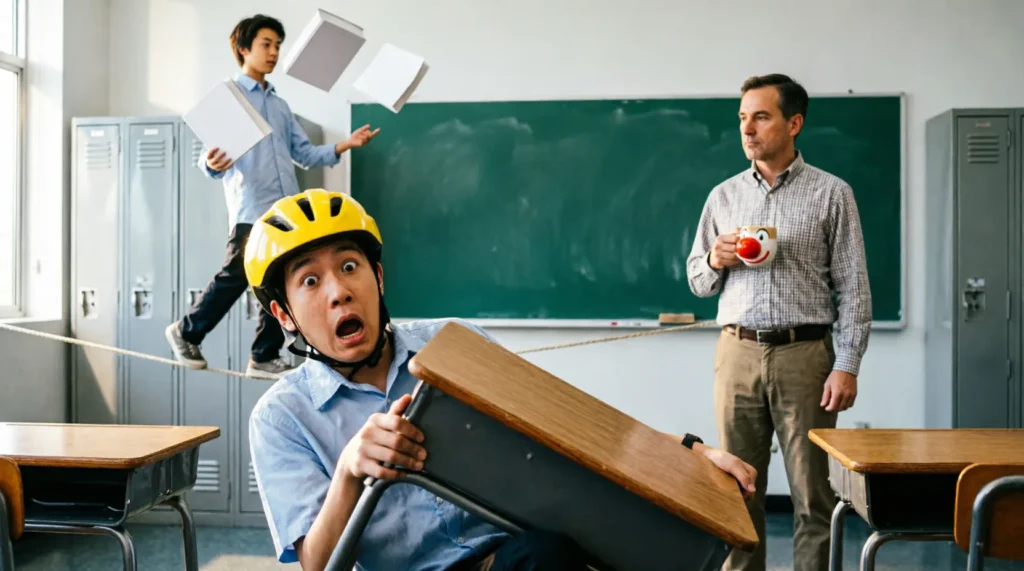
School can feel like a rollercoaster that nobody asked to ride, but the right comparison can turn those chaotic moments into comedy gold. The similes below capture everything from Monday morning dread to that panic when you realize the homework was due yesterday, giving you ready-made lines that your classmates will actually want to borrow. Use them in essays, yearbook quotes, or just to survive another group project with your sanity intact.
Morning Madness & Getting to Class
The rush to get ready and out the door creates a special kind of chaos that only students understand. These similes capture that frantic energy when the alarm goes off way too early.
“Like a zombie shuffling to first period” — “I moved through the hallway like a zombie shuffling to first period, brain still buffering.” (exhausted, relatable)
“Like a squirrel on espresso” — “Before my coffee, I’m like a squirrel on espresso—jittery but somehow functional.” (wired, chaotic energy) Craft note: The alliteration in “squirrel on espresso” creates a bouncy rhythm that mirrors the frantic energy itself.
“Like a tornado in a backpack” — “My morning routine is like a tornado in a backpack—everything’s flying and nothing’s where it should be.” (disorganized, frantic)
“Like a phone at 1% battery” — “By second period, I’m running like a phone at 1% battery, just trying to make it to lunch.” (drained, barely functioning)
“Like a goldfish with ADHD” — “In the morning, my focus is like a goldfish with ADHD—constantly darting in new directions.” (scattered, unfocused)
“Like a sloth on a treadmill” — “Getting to class on time feels like being a sloth on a treadmill—lots of effort, minimal progress.” (slow, struggling) Craft note: The visual contradiction between a sloth’s natural slowness and a treadmill’s constant motion creates instant humor through incongruity.
“Like a broken record player” — “My alarm went off like a broken record player, stuck on repeat while I hit snooze.” (repetitive, annoying)
“Like a penguin on ice” — “Walking to class in new shoes, I slid like a penguin on ice—graceful in theory, disastrous in practice.” (clumsy, awkward)
Teachers & Classroom Moments
Every student has encountered that one teacher who seems to have superhuman abilities or quirks that defy explanation. These comparisons celebrate the colorful characters who populate our schools.
“Like a human Wikipedia page” — “Mr. Johnson is like a human Wikipedia page; ask him anything and he’s got the answer before you finish the question.” (knowledgeable, impressive) Craft note: Comparing a person to Wikipedia works because it’s instantly recognizable as the go-to source for random facts, making the praise both modern and specific.
“Like a detective with a magnifying glass” — “Our teacher watches us during tests like a detective with a magnifying glass, catching every glance sideways.” (suspicious, vigilant)
“Like a broken GPS” — “When the substitute gave directions, it was like following a broken GPS—constantly recalculating and still lost.” (confusing, unreliable)
“Like a stand-up comedian” — “Ms. Rodriguez tells jokes like a stand-up comedian; even the boring stuff becomes hilarious.” (entertaining, engaging)
“Like a drill sergeant” — “The gym coach yells like a drill sergeant; I’m pretty sure he’s training us for war, not dodgeball.” (intense, intimidating) This one’s overused—every sports movie has it. Try something fresher unless you’re going for deliberate cliché.
“Like a broken thermostat” — “Our classroom temperature is like a broken thermostat—either Arctic tundra or Sahara desert, never just right.” (uncomfortable, inconsistent)
“Like a fortune cookie” — “My teacher’s advice is like a fortune cookie—vague enough to apply to everything, specific enough to seem wise.” (mysterious, philosophical)
Homework & Study Struggles
The eternal battle between students and their assignments deserves its own category of similes. These capture the unique pain of realizing you have three projects due tomorrow.
“Like trying to herd cats” — “Organizing our group project is like trying to herd cats—everyone’s going their own direction.” (chaotic, frustrating) Craft note: “Herding cats” works because it’s a universally understood image of impossible coordination, making it instantly relatable for anyone who’s done group work.
“Like reading ancient hieroglyphics” — “My math homework looks like ancient hieroglyphics; I have no idea what any of it means.” (confusing, indecipherable)
“Like building a sandcastle at high tide” — “Studying the night before feels like building a sandcastle at high tide—pointless and doomed.” (futile, desperate)
“Like a hamster on a wheel” — “I’ve been studying for hours like a hamster on a wheel—lots of motion, going nowhere.” (exhausting, unproductive)
“Like decoding alien transmissions” — “The chemistry assignment is like decoding alien transmissions; the symbols make no sense to Earthlings.” (baffling, otherworldly)
“Like trying to fill a bucket with a hole” — “Memorizing for this test is like trying to fill a bucket with a hole—everything leaks out immediately.” (forgetful, frustrating)
“Like a Netflix series that never ends” — “This reading assignment is like a Netflix series that never ends; I keep thinking I’m almost done, but there’s always more.” (endless, overwhelming) Craft note: The Netflix comparison lands because it captures that specific modern experience of binge-watching something you can’t escape, updated from the old “like a bad movie” cliché.
Tests & Exams
Nothing creates panic quite like test day. These similes capture that special blend of dread, confusion, and desperate hope that defines exam season.
“Like walking through a minefield” — “Taking this multiple-choice test is like walking through a minefield; every answer could blow up my grade.” (dangerous, stressful)
“Like a game of Russian roulette” — “Guessing on this exam feels like a game of Russian roulette—I might get lucky, or I might fail spectacularly.” (risky, uncertain)
“Like trying to catch smoke” — “The essay questions are like trying to catch smoke; the ideas are there but impossible to grab.” (elusive, frustrating)
“Like defusing a bomb” — “Checking my answers is like defusing a bomb—one wrong move and everything explodes.” (tense, high-stakes)
“Like speaking a foreign language” — “The advanced placement test might as well be in a foreign language; I recognize the words but not the meaning.” (incomprehensible, alien) This is tired and lazy—skip it unless you’re actually taking a language exam. Find a fresher comparison.
“Like a horror movie jump scare” — “Seeing the first question was like a horror movie jump scare; I wasn’t prepared for that level of terror.” (shocking, scary)
“Like running a marathon in flip-flops” — “Taking this final without studying is like running a marathon in flip-flops—technically possible, but why would you do that to yourself?” (unprepared, painful) Craft note: The specific detail of “flip-flops” makes this funnier than just “running a marathon”—it’s the inappropriate footwear that sells the absurdity.
Cafeteria & Lunchtime Chaos
The school cafeteria operates by its own mysterious rules, creating situations that demand creative description. These similes capture the unique experience of navigating lunch period.
“Like a zoo during feeding time” — “The cafeteria at noon is like a zoo during feeding time—loud, chaotic, and slightly dangerous.” (wild, overwhelming)
“Like a game of musical chairs” — “Finding a seat at lunch is like a game of musical chairs; if you’re not fast enough, you’re standing.” (competitive, frantic)
“Like a science experiment gone wrong” — “The mystery meat today looks like a science experiment gone wrong; I’m not sure it’s actually food.” (suspicious, gross)
“Like a reality TV show” — “Our lunch table drama is like a reality TV show; everyone’s performing and nobody’s being real.” (dramatic, fake)
“Like a black hole” — “My lunch money disappears like it’s entering a black hole; I have no idea where it all goes.” (mysterious, vanishing)
“Like a gladiator arena” — “Getting to the pizza line first is like entering a gladiator arena—only the strongest survive.” (competitive, intense) Craft note: Elevating pizza to gladiatorial combat creates humor through extreme exaggeration, making something mundane feel epic and ridiculous.
“Like a soap opera” — “The lunchroom gossip spreads like a soap opera; by third period, everyone knows everyone’s business.” (dramatic, fast-moving)
End of Day & School Events
The final bell can’t come soon enough, but not before navigating assemblies, sports, and the general exhaustion of a full school day. These similes capture that home-stretch energy.
“Like a deflating balloon” — “By last period, I’m like a deflating balloon—all the energy has slowly leaked out.” (exhausted, deflated)
“Like a rocket ready to launch” — “When the bell rings, I take off like a rocket ready to launch; nothing can stop me from getting out.” (eager, fast)
“Like a marathon runner hitting the wall” — “By Friday afternoon, I’m like a marathon runner hitting the wall; I’m running on fumes and determination.” (exhausted, pushing through)
“Like a circus without a ringmaster” — “School assemblies are like a circus without a ringmaster—chaotic, loud, and nobody’s in control.” (disorganized, wild)
“Like a rollercoaster that won’t stop” — “This school year has been like a rollercoaster that won’t stop; I just want to get off.” (overwhelming, endless)
“Like a phoenix rising” — “Monday morning after the weekend feels like being a phoenix rising—except the phoenix is tired and doesn’t want to rise.” (reluctant, exhausted) Craft note: Subverting the inspirational phoenix metaphor by adding the tired reality creates humor through expectation reversal.
“Like a broken clock” — “The school schedule is like a broken clock; somehow it’s always the wrong time for something.” (confusing, unreliable)
How to Write Your Own School Simile
Creating fresh similes is easier than you think, and it’ll make your writing stand out from the generic “school is hard” complaints everyone else uses. Here’s my three-step process that I teach in every workshop:
Step 1: Identify the specific feeling or situation. Don’t just say “school is stressful”—pinpoint exactly what moment. Is it the panic of forgetting your homework? The awkwardness of presenting in front of class? The exhaustion of back-to-back tests?
Step 2: Brainstorm comparisons from unexpected categories. Instead of reaching for the first thing that comes to mind (everyone thinks of “like a zombie”), push yourself to think of three weird options. What about video games? Cooking disasters? Weather phenomena? Technology glitches?
Step 3: Test for specificity and surprise. Read it aloud. Does it make someone smile or nod in recognition? If it sounds like a greeting card, scrap it and try again.
Worked example: Let’s say you want to describe waiting for grades to be posted online.
Weak version: “Waiting for grades is like waiting for Christmas.” (Boring, overused, vague)
Better version: “Waiting for grades is like refreshing a webpage that won’t load—click, click, click, still nothing, and you’re pretty sure it’s broken.” (Specific, modern, captures the repetitive anxiety)
Frequently Asked Questions
What makes a simile different from a metaphor?
A simile directly compares two things using “like” or “as,” while a metaphor states that one thing is another. So “homework is like a monster” is a simile, but “homework is a monster” is a metaphor. According to Wikipedia’s entry on similes, this explicit comparison marker is what distinguishes the two figures of speech.
Why should students use similes in their writing?
Similes make abstract feelings concrete and relatable. Instead of saying “I was nervous about the test,” saying “I was like a mouse in a room full of cats” creates an instant visual that your reader understands emotionally. They’re particularly useful in college essays and personal statements where you need to show personality and creativity.
How can I avoid clichéd similes?
The key is specificity and freshness. Instead of “busy as a bee,” try “busy like my phone during group chat drama.” Think about comparisons from your actual life—video games, social media, streaming services, memes—rather than reaching for the same old phrases from elementary school. If you’ve heard it in a movie or on a motivational poster, it’s probably too worn out to use.
Can funny similes work in serious academic writing?
Yes, but strategically. According to research on student writing, appropriate humor can actually improve engagement and retention when used sparingly. A well-placed funny simile in an introduction or conclusion can make your essay memorable without undermining your argument. Just avoid them in thesis statements or when discussing serious topics where they’d seem disrespectful.

Justin Brown is a seasoned literary analyst with over 15 years of experience in the field of linguistics and literary studies. Holding a master’s degree in English Literature from the University of Chicago, Justin has devoted much of his career to exploring the nuances of similes and other forms of figurative language. His passion for deciphering the layers of meaning in literary works was kindled during his undergraduate years, where he was intrigued by the power of metaphorical language. Justin frequently contributes to VividSimiles by crafting engaging articles that decode the application of similes in both classical and contemporary literature. His insightful analyses help readers grasp the beauty and complexity of figurative expressions, making literature more accessible to all. In addition to writing, Justin conducts workshops for aspiring writers, nurturing their abilities to use language vividly and effectively.