

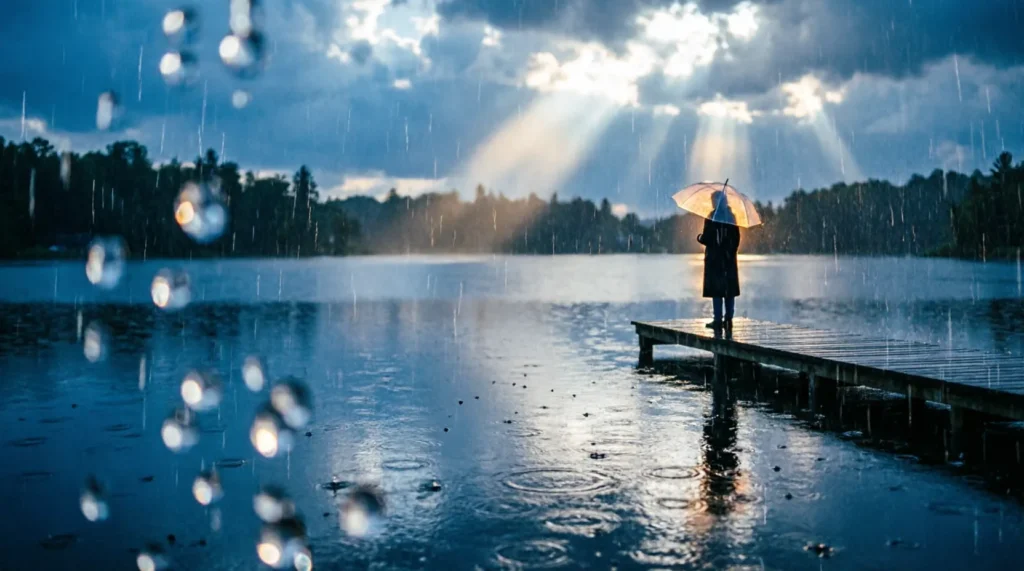
When you’re searching for the perfect simile for the rain was like, you’re looking for language that captures rain’s many moods—from gentle whispers to furious downpours. The examples below are organized by feeling and intensity so you can drop them straight into your poem, story, or essay and immediately strengthen your imagery.
What Is a Simile?
A simile is a figure of speech that directly compares two different things using “like” or “as.” According to Wikipedia’s entry on similes, this literary device creates vivid imagery by highlighting similarities between seemingly unrelated objects or experiences. Unlike a metaphor, which states that one thing is another, a simile maintains the distinction while drawing a parallel—saying the rain is like something else, not that it is that thing.
Gentle and Soothing Rain
These similes work beautifully when you’re writing about comfort, peace, or quiet moments. They’re my students’ go-to choice for scenes of reflection or tenderness.
- “as gentle as a whisper” — “The rain fell as gentle as a whisper against the windowpane.” (soft, intimate)
- “soft as a mother’s touch” — “The spring rain came down soft as a mother’s touch.” (nurturing, warm)
- “like a lullaby sung by the sky” — “She drifted to sleep as the rain played like a lullaby sung by the sky.” (calming, musical) — Craft note: The personification of the sky “singing” adds emotional depth beyond the basic comparison.
- “as light as a sigh” — “The misty rain was as light as a sigh, barely there at all.” (delicate, fleeting)
- “like fingers tracing glass” — “The rain tapped like fingers tracing glass, searching for a way in.” (tentative, curious)
- “as quiet as falling snow” — “Surprisingly, the rain was as quiet as falling snow that afternoon.” (peaceful, unexpected)
- “like a secret being told” — “The gentle rain sounded like a secret being told, just for us.” (intimate, confidential)
These softer comparisons work especially well in romantic scenes, children’s literature, or any moment where you want to evoke safety and tranquility.
Heavy and Intense Rain
When the storm hits hard, you need similes with weight and force. These are the ones I reach for in action scenes or moments of crisis.
- “like a waterfall from the heavens” — “The rain came down like a waterfall from the heavens, flooding the streets in minutes.” (overwhelming, dramatic)
- “as heavy as stones” — “Each drop felt as heavy as stones against my umbrella.” (punishing, oppressive)
- “like bullets from the sky” — “The storm unleashed rain like bullets from the sky.” (violent, dangerous) — Craft note: This simile’s power comes from its association with danger and speed; it instantly raises stakes.
- “relentless as a punishment” — “The rain was relentless as a punishment, never letting up for hours.” (harsh, unforgiving)
- “like a curtain of beads” — “The rain fell like a curtain of beads, hiding the world beyond.” (dense, visual)
- “as constant as a heartbeat” — “Through the night, the rain was as constant as a heartbeat.” (steady, inescapable)
- “like the sky had broken open” — “It was raining like the sky had broken open and poured out everything it held.” (catastrophic, biblical)
- “as fierce as a wild animal” — “The rain attacked as fierce as a wild animal, tearing at the roof.” (aggressive, primal)
Skip the tired “raining cats and dogs” cliché—it’s been overused since the 1700s and adds nothing fresh to your writing. These alternatives actually create visual impact.
Melancholic and Emotional Rain
Rain and sadness have walked together through literature for centuries. These similes tap into that emotional resonance without being heavy-handed.
- “like tears from heaven” — “The rain fell like tears from heaven, washing over the grieving town.” (sorrowful, sympathetic)
- “as sad as a forgotten song” — “The drizzle was as sad as a forgotten song, trailing off into silence.” (wistful, nostalgic)
- “like the sky was weeping” — “All afternoon, the rain continued like the sky was weeping.” (mournful, empathetic)
- “as gray as a memory fading” — “The rain fell in a haze as gray as a memory fading.” (uncertain, distant)
- “like a heart breaking slowly” — “The steady rain sounded like a heart breaking slowly, drop by drop.” (painful, gradual) — Craft note: The “drop by drop” addition mirrors the slow accumulation of grief, making the comparison work on multiple levels.
- “as lonely as an empty street” — “The rain tapped as lonely as an empty street at midnight.” (isolated, quiet)
- “like a goodbye left unsaid” — “The rain lingered like a goodbye left unsaid.” (regretful, lingering)
These work particularly well in literary fiction, poetry, or any scene dealing with loss, longing, or introspection.
Cleansing and Renewing Rain
Not all rain is gloomy—sometimes it represents fresh starts and purification. According to Wikipedia’s article on rain, rain plays a crucial role in Earth’s water cycle and ecosystem renewal, which is why these similes resonate so deeply across cultures.
- “as purifying as a baptism” — “The rain washed over her, as purifying as a baptism.” (spiritual, transformative)
- “like a fresh beginning” — “After the drought, the rain arrived like a fresh beginning.” (hopeful, restorative)
- “as refreshing as a cool drink” — “The summer rain was as refreshing as a cool drink on a hot day.” (relieving, welcome)
- “like the earth exhaling” — “The rain came down like the earth exhaling after holding its breath too long.” (relieved, natural)
- “as cleansing as forgiveness” — “The storm’s rain felt as cleansing as forgiveness.” (redemptive, peaceful)
- “like a reset button for the world” — “The heavy rain hit like a reset button for the world.” (transformative, powerful)
- “as life-giving as a mother’s milk” — “To the parched fields, the rain was as life-giving as a mother’s milk.” (nourishing, essential) — Craft note: This simile’s strength lies in its universal association with sustenance and survival.
These similes shine in scenes of recovery, growth, or transformation—perfect for character arcs or seasonal transitions.
Musical and Rhythmic Rain
Rain creates natural percussion, and these similes capture its sonic qualities. Use them when sound is central to your scene.
- “like a thousand tiny drums” — “The rain hammered the roof like a thousand tiny drums.” (energetic, rhythmic)
- “as rhythmic as a heartbeat” — “The rain fell as rhythmic as a heartbeat, steady and sure.” (consistent, alive)
- “like a symphony on the roof” — “I lay awake listening to the rain play like a symphony on the roof.” (complex, beautiful)
- “as musical as a piano” — “The rain against the window was as musical as a piano.” (melodic, pleasant)
- “like applause from the clouds” — “The sudden downpour came like applause from the clouds.” (celebratory, unexpected)
- “as steady as a metronome” — “The rain tapped as steady as a metronome, marking time.” (precise, regular)
- “like nature’s percussion section” — “The storm’s rain sounded like nature’s percussion section warming up.” (playful, dynamic)
These work wonderfully in scenes where characters are listening, waiting, or finding comfort in sound.
How to Write Your Own Rain Simile
Creating original similes for rain doesn’t require genius—it requires observation and a willingness to make unexpected connections. Here’s my three-step process that I teach in every workshop:
Step 1: Identify the specific quality of rain you want to capture. Is it the sound, the weight, the visual pattern, the emotional effect, or the temperature? Don’t try to capture everything at once.
Step 2: Brainstorm objects, experiences, or sensations that share that quality. If you’re focusing on sound, think about music, machinery, nature sounds, or human voices. If it’s about weight, consider physical objects, emotions, or consequences.
Step 3: Test your comparison by asking: Does this create a clear image? Is it fresh enough to hold attention? Does it fit the tone of my piece?
Worked example: Let’s say you’re writing about rain that won’t stop during a camping trip. The quality you want is persistence. Brainstorm persistent things: a dripping faucet, a bad cold, an annoying song stuck in your head, a toddler asking “why.” Now test them: “The rain was persistent as a dripping faucet” works but is somewhat expected. “The rain followed us like a bad cold we couldn’t shake” is better—it adds the element of unwanted companionship. That’s your winner.
Frequently Asked Questions
What’s the difference between a simile and a metaphor for rain? A simile for rain uses “like” or “as” to make the comparison explicit (“the rain was like a curtain”), while a metaphor states the rain is something else (“the rain was a curtain”). Similes are generally clearer and safer for beginning writers; metaphors require more skill to execute without confusing your reader.
How do I avoid clichés when writing rain similes? Steer clear of “raining cats and dogs,” “it’s raining buckets,” or “the heavens opened.” Instead, focus on specific sensory details unique to your scene. What does this particular rain sound like, feel like, or remind you of? Specificity is the enemy of cliché.
Can I mix multiple rain similes in one paragraph? Yes, but use them sparingly. One strong simile per paragraph is usually enough. Multiple similes can overwhelm your reader or make your writing feel overwritten. Choose the comparison that best serves your scene’s mood and purpose.
What makes a rain simile effective versus just decorative? An effective simile reveals something new about the rain or the character experiencing it. If your simile could be removed without changing the meaning or emotional impact, it’s just decoration. The best similes pull double duty—they describe the rain while also advancing character, mood, or theme.

Brian Walker is an esteemed linguist with a Ph.D. in Language and Literature from Stanford University. Over the past 20 years, Brian has dedicated his research to understanding the impact of figurative language on communication and literature. His extensive body of work includes scholarly articles that have been published in numerous academic journals. Brian’s fascination with similes emerged during his doctoral studies, where he examined their role in enhancing rhetorical persuasion and emotional resonance. As a contributor to VividSimiles, he writes detailed analyses on the historical evolution of similes and their varied applications across different cultures and languages. Brian’s articles are known for their depth and clarity, bridging the gap between academic research and practical application. He is committed to enlightening readers about the intricacies of language and the beauty of well-crafted similes.