

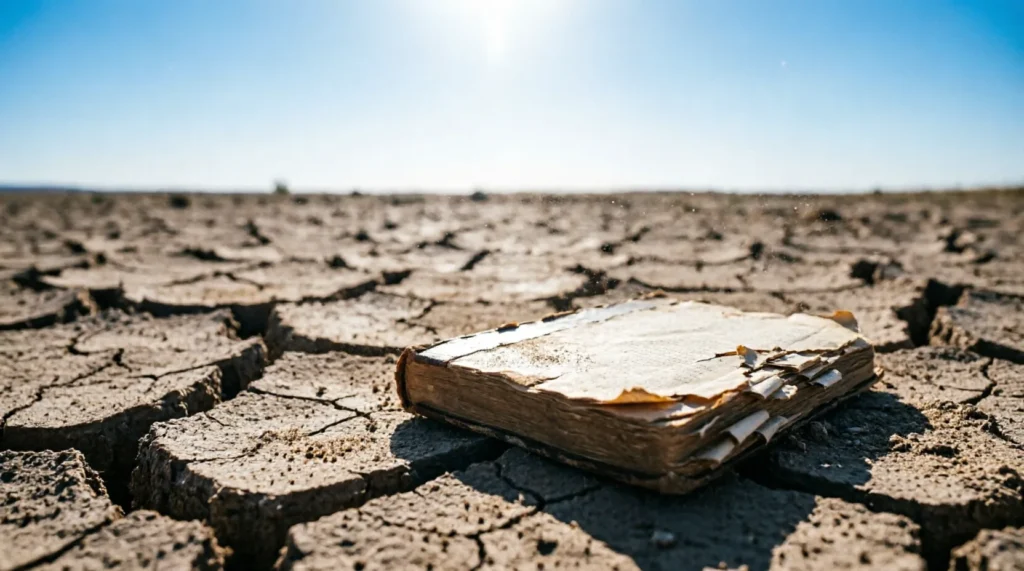
Similes describing parched conditions do more than state that something is dry; they evoke the tactile sensation of cracked earth, the ache of thirst, or the emotional barrenness of a lonely room. The collection below organizes these comparisons by intensity and context so you can select the precise shade of desiccation your scene requires. Each entry includes a ready-to-use sentence and a tone note to ensure the image lands with the intended emotional weight.
What Is a Simile?
A simile is a figure of speech that explicitly compares two unlike things using “like” or “as,” creating a bridge between the familiar and the abstract to sharpen sensory detail. According to Simile, this direct comparison distinguishes the device from metaphor, which asserts an identity rather than a resemblance. When writing about extreme dryness, a simile allows you to borrow the physical properties of one arid object to illuminate another without claiming they are literally the same thing.
Physical Dryness and Environmental Aridity
These similes anchor the reader in tangible, observable dryness, making them ideal for setting descriptions in fiction, travel writing, or nature journalism where the landscape itself functions as a character.
- “as parched as sun-baked clay” — “The riverbed lay as parched as sun-baked clay, a mosaic of fissures stretching toward the horizon.” (descriptive, geological). The plosive “k” sounds in “baked” and “clay” mimic the hardness of the surface, reinforcing the visual with phonetic texture.
- “as parched as a desert wadi” — “After three months without rain, the valley floor was as parched as a desert wadi.” (stark, factual). This works best in nonfiction or realist fiction where geographic accuracy matters more than lyrical flourish.
- “as parched as old parchment” — “The manuscript pages felt as parched as old parchment, brittle enough to disintegrate at a touch.” (tactile, historical). Use this when dryness carries connotations of age, fragility, or lost knowledge.
- “as parched as kiln-dried timber” — “The lumber stack sat as parched as kiln-dried timber, moisture long since driven out by industrial heat.” (technical, precise). Avoid this in poetic contexts; its strength lies in specificity for trade or craft writing.
- “as parched as salt flats at noon” — “The playa stretched before us, as parched as salt flats at noon, blinding and absolute.” (extreme, sensory). The temporal marker “at noon” adds thermal intensity that bare “salt flats” lacks.
- “as parched as a mummy’s wrappings” — “The linen bandages were as parched as a mummy’s wrappings, preserved but utterly lifeless.” (macabre, archaeological). Reserve for horror, dark fantasy, or museum-set narratives where dryness intersects with death.
- “as parched as dust on a windowsill” — “The attic air tasted as parched as dust on a windowsill, undisturbed for decades.” (domestic, melancholic). This domestic scale makes aridity intimate rather than epic, suitable for memoir or family saga.
- “as parched as volcanic ash” — “The soil after the eruption was as parched as volcanic ash, sterile and grey.” (cataclysmic, scientific). Best deployed in disaster narratives or ecological writing where dryness signals destruction rather than mere absence.
Bodily Thirst and Physiological Dehydration
When characters experience thirst, the simile must convey internal sensation rather than external observation, making these examples essential for first-person narration, medical thrillers, or survival stories.
- “as parched as a marathoner at mile twenty” — “Her throat was as parched as a marathoner at mile twenty, each swallow a conscious effort.” (kinesthetic, urgent). The specificity of “mile twenty” grounds the simile in lived athletic experience rather than generic exhaustion.
- “as parched as sandpaper dragged across the tongue” — “He woke with a mouth as parched as sandpaper dragged across the tongue.” (visceral, uncomfortable). The active verb “dragged” creates motion and friction that static adjectives cannot achieve; my students often default to “dry as sandpaper,” but adding the verb transforms cliché into sensation.
- “as parched as a canteen left open in the sun” — “His lips were as parched as a canteen left open in the sun, leather-stiff and cracked.” (situational, nostalgic). Evokes military or outdoor adventure contexts where equipment failure mirrors bodily failure.
- “as parched as fever-dream cotton” — “She swallowed against a throat as parched as fever-dream cotton, thick and unyielding.” (surreal, ill). Useful in illness narratives where dehydration blends with delirium; the compound modifier “fever-dream” signals altered perception.
- “as parched as a sponge wrung bone-dry” — “After the vomiting stopped, his stomach felt as parched as a sponge wrung bone-dry.” (clinical, raw). Appropriate for medical or trauma writing where bodily functions are described without euphemism.
- “as parched as wind-chapped skin” — “Her cheeks were as parched as wind-chapped skin, stinging with every blink.” (localized, painful). Focuses dryness on a specific body part, avoiding the vagueness of whole-body descriptions.
- “as parched as a camel’s hump after crossing” — “He drank greedily, his body as parched as a camel’s hump after crossing.” (allusive, rhythmic). Draws on cultural knowledge of desert survival; the trochaic rhythm of “after crossing” mimics the gait of the animal referenced.
- “as parched as a hangover at dawn” — “Morning found him as parched as a hangover at dawn, regretting every toast.” (colloquial, self-deprecating). Fits contemporary fiction or personal essay where bodily discomfort carries social or moral subtext.
Emotional Barrenness and Spiritual Desolation
Dryness as metaphor for inner emptiness demands similes that resonate psychologically, serving literary fiction, poetry, eulogies, or therapeutic writing where landscape mirrors psyche.
- “as parched as a widow’s garden” — “Since the funeral, her spirit had been as parched as a widow’s garden, untended and overgrown with grief.” (elegiac, gendered). The domestic space externalizes mourning; avoid if the character’s gender isn’t relevant to the emotional arc.
- “as parched as an unanswered prayer” — “Years of silence left his faith as parched as an unanswered prayer.” (spiritual, resigned). Works in religious or existential narratives where dryness signifies divine absence rather than punishment.
- “as parched as a childhood home sold to strangers” — “Returning to the empty house, she felt as parched as a childhood home sold to strangers.” (nostalgic, dispossessed). Ties dryness to loss of belonging; the specificity of “sold to strangers” prevents sentimentality.
- “as parched as a poet’s well after fame” — “Success had left him as parched as a poet’s well after fame, celebrated but creatively hollow.” (ironic, cautionary). Addresses artistic burnout; the juxtaposition of “fame” and “parched” creates productive tension.
- “as parched as a reconciliation never spoken” — “Their marriage remained as parched as a reconciliation never spoken, polite but arid.” (relational, tense). Ideal for domestic drama where silence performs the work of drought.
- “as parched as a library closed for renovation” — “During the lockdown, his mind felt as parched as a library closed for renovation, starved of nourishment.” (intellectual, temporary). Suits academic or pandemic-era writing where deprivation is circumstantial rather than permanent.
- “as parched as a lullaby sung to no one” — “Her loneliness was as parched as a lullaby sung to no one, tender but futile.” (maternal, sorrowful). The auditory dimension of “sung” contrasts with the tactile expectation of “parched,” deepening the pathos through synesthesia.
- “as parched as a promise broken in youth” — “Trust, once shattered, left him as parched as a promise broken in youth.” (formative, enduring). Anchors emotional dryness to a specific developmental wound, avoiding vague melancholy.
Creative Variations and Unexpected Pairings
For writers seeking freshness beyond conventional associations, these similes surprise through incongruity while remaining logically coherent, perfect for speculative fiction, experimental prose, or song lyrics where originality signals voice.
- “as parched as a data center’s cooling failure” — “The server room hummed, its air as parched as a data center’s cooling failure.” (technological, dystopian). Transplants aridity into digital infrastructure; effective in cyberpunk or climate-fiction where systems collapse mirrors ecological crisis.
- “as parched as a stand-up comic’s silence” — “The audience sat in a quiet as parched as a stand-up comic’s silence, waiting for relief that wouldn’t come.” (performative, awkward). Uses social discomfort as dryness; the simile earns its place because both conditions involve unbearable absence.
- “as parched as a vinyl record left on a radiator” — “The melody sounded as parched as a vinyl record left on a radiator, warped and thin.” (auditory, degraded). Applies dryness to sound quality; the material specificity of “vinyl” and “radiator” prevents abstraction.
- “as parched as a divorce lawyer’s empathy” — “His counsel was as parched as a divorce lawyer’s empathy, efficient but devoid of warmth.” (professional, cynical). Critiques institutional emotional labor; the simile works because it names a role where dryness is functional, not accidental.
- “as parched as a spaceship’s recycled air” — “Month six aboard the vessel, every breath tasted as parched as a spaceship’s recycled air.” (sci-fi, claustrophobic). Grounds futuristic setting in bodily reality; the technical term “recycled” adds verisimilitude that “stale air” lacks.
- “as parched as a museum exhibit behind glass” — “Her smile was as parched as a museum exhibit behind glass, preserved but unreachable.” (curatorial, distant). Reframes emotional unavailability as archival display; the barrier of “glass” makes the dryness spatial as well as affective.
- “as parched as a canceled festival field” — “The meadow stood as parched as a canceled festival field, trampled grass baking under unused stages.” (communal, disappointed). Links dryness to collective anticipation thwarted; the detail “unused stages” carries narrative weight beyond mere description.
- “as parched as a deleted voicemail” — “His apology arrived as parched as a deleted voicemail, present only in its absence.” (digital, ephemeral). Explores how technology mediates emotional expression; the paradox of “present only in its absence” elevates the simile beyond simple comparison.
How to Write Your Own Parched Simile
Crafting an original simile for dryness begins not with brainstorming adjectives but with identifying the precise type of parchedness your scene demands—physical, emotional, or systemic. Ask yourself what the dryness is doing narratively: Is it punishing a character? Reflecting a setting’s hostility? Mirroring an internal void? The function determines the vehicle. For more, see Parched.
Next, select a source domain that shares not just the quality of dryness but the appropriate connotation and scale. Comparing a child’s thirsty mouth to “sun-baked clay” mismatches vulnerability with geological permanence; “a juice box squeezed empty” honors both the smallness and the desperation. Test your pairing by reading it aloud—if the rhythm stumbles or the image feels borrowed, refine until sound and sense align.
Finally, embed the simile in action or sensation rather than static description. Instead of “Her heart was as parched as a desert,” try “She reached for his hand and found her palm as parched as a desert, pulling back before he could feel the grit.” The revision places dryness within a moment of failed connection, making the simile earn its keep through narrative consequence rather than decorative ornament. My workshop students who adopt this practice consistently produce similes that advance plot instead of pausing it.
Frequently Asked Questions
Is “as parched as a desert” too clichéd to use? Yes, in most contexts. The phrase has been drained of sensory specificity through overuse in advertising and mediocre prose. If you must reference desert dryness, specify the type of desert, the time of day, or a particular feature—”as parched as a Sonoran wash at dusk”—to restore texture and demonstrate observational rigor rather than reaching for the nearest available trope.
Can I use “parched” similes for non-literal subjects like creativity or relationships? Absolutely, provided the emotional or conceptual dryness parallels physical aridity in a way that illuminates rather than obscures. The key is ensuring your reader can map the source domain’s properties onto the target: a “parched” creative block implies not just absence but active depletion, whereas “empty” might suggest neutral vacancy. Always test whether the simile adds nuance that plain language cannot.
How do I avoid mixing metaphors when combining parched similes with other figurative language? Maintain consistency within a single descriptive passage by anchoring all images to the same elemental register. If you describe a character’s voice as “as parched as cracked earth,” don’t follow it with “her words flowed like honey”; the hydrological contradiction undermines both images. Either sustain the aridity cluster or transition deliberately with a bridging sentence that acknowledges the shift in sensory mode.
What makes a parched simile effective in dialogue versus narration? In dialogue, similes should reflect the speaker’s vocabulary, education, and emotional state—a farmer might say “as parched as August stubble,” while a teenager might say “as parched as my phone battery at 1%.” Narration permits greater lyrical freedom, but even there, the simile should serve the point of view’s perceptual habits. Forced poeticism in a pragmatic character’s mouth breaks immersion faster than any technical flaw.


Brian Walker is an esteemed linguist with a Ph.D. in Language and Literature from Stanford University. Over the past 20 years, Brian has dedicated his research to understanding the impact of figurative language on communication and literature. His extensive body of work includes scholarly articles that have been published in numerous academic journals. Brian’s fascination with similes emerged during his doctoral studies, where he examined their role in enhancing rhetorical persuasion and emotional resonance. As a contributor to VividSimiles, he writes detailed analyses on the historical evolution of similes and their varied applications across different cultures and languages. Brian’s articles are known for their depth and clarity, bridging the gap between academic research and practical application. He is committed to enlightening readers about the intricacies of language and the beauty of well-crafted similes.