

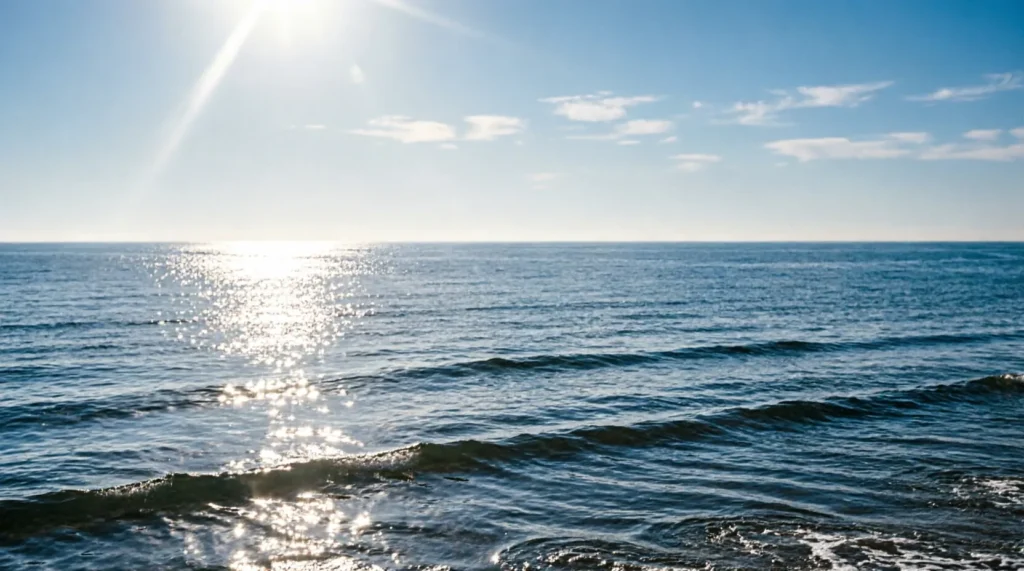
When you are trying to describe the sea, plain adjectives often fall flat. The ocean is too vast, too violent, and too beautiful for words like “big” or “blue” to carry the weight of its presence. This is where figurative language steps in. By comparing the ocean to something else entirely, you allow your reader to feel the salt spray, hear the crash of waves, and sense the terrifying depth without you having to list every physical detail. The examples below are curated to help you find the perfect comparison for your specific scene, whether you are writing a tranquil beach memory or a storm-tossed thriller.
What Is a Metaphor?
Before we dive into the water, it helps to clarify our tools. A metaphor is a figure of speech that directly compares two unrelated things by stating that one thing is the other 1. Unlike a simile, which uses “like” or “as” to make a comparison (e.g., “the ocean is like a beast”), a metaphor asserts identity (e.g., “the ocean is a beast”). This direct assertion creates a stronger, more immediate image in the reader’s mind. It collapses the distance between the subject and the comparison, forcing the reader to accept the new reality you have created. While similes are gentle suggestions, metaphors are bold declarations.
The Ocean as a Living Entity
One of the most powerful ways to describe the sea is to give it agency. The ocean is not just water; it breathes, hunts, sleeps, and rages. Personifying the ocean makes it a character in your story rather than just a setting.
- “The ocean is a hungry mouth.” — “We stood on the cliff edge, watching the ocean, a hungry mouth, chew at the base of the rocks.” (Menacing, predatory). This works because it transforms the passive act of erosion into an active, violent consumption.
- “The sea is a sleeping giant.” — “At dawn, the sea was a sleeping giant, its chest rising and falling with the slow rhythm of the tide.” (Peaceful, ominous). The craft note here is the rhythm; the long vowels in “sleeping giant” mimic the slow, heavy breath of the tide.
- “The water is a jealous lover.” — “It pulled him under with the possessive grip of a jealous lover who refuses to let go.” (Intense, dangerous). This captures the suffocating nature of drowning without using clinical terms.
- “The ocean is an old god.” — “We sacrificed our pride to the ocean, an old god who demands respect but offers no mercy.” (Reverent, ancient). This taps into the historical human fear of the sea as a divine, untamable force.
- “The tide is a breathing lung.” — “The bay expanded and contracted, the tide a breathing lung inhaling the sand and exhaling the foam.” (Organic, rhythmic). This is a favorite among my students because it connects the macro scale of the ocean to the micro scale of human biology.
- “The sea is a fickle friend.” — “One minute it offered us calm waters, and the next it turned on us; the sea is a fickle friend who smiles while holding a knife.” (Untrustworthy, volatile).
Avoid the cliché “the ocean is alive.” It is too vague. Instead, specify how it is alive. Is it angry? Tired? Playful? Specificity creates imagery.
The Ocean as a Force of Chaos
When the weather turns, the ocean stops being a backdrop and becomes an antagonist. These metaphors focus on violence, noise, and destruction. They are essential for action scenes or moments of high emotional turmoil.
- “The waves are white-knuckled fists.” — “The storm broke, and the waves became white-knuckled fists pounding against the hull.” (Violent, aggressive). The visual of “white-knuckled” connects the foam of the wave to human tension and anger.
- “The ocean is a thrashing beast.” — “There was no calm, only the ocean, a thrashing beast trying to shake us from its back.” (Chaotic, uncontrollable). This metaphor emphasizes the lack of control the sailors have.
- “The sea is a grinding mill.” — “The rocks were reduced to sand by the sea, a grinding mill that never stops its work.” (Relentless, industrial). This shifts the tone from emotional anger to mechanical, unfeeling destruction.
- “The water is a chaotic symphony.” — “The crash of the breakers was not noise but a chaotic symphony, each wave a discordant note in a song of destruction.” (Loud, overwhelming). Using “symphony” ironically highlights the complexity of the sound.
- “The ocean is a riot.” — “The surface was no longer water but a riot, churning and boiling with unchecked energy.” (Disordered, violent). This captures the visual confusion of a storm-tossed sea.
- “The waves are hammer blows.” — “Each crest hit the seawall like a hammer blow, testing the integrity of the stone.” (Percussive, heavy). The short, hard consonants in “hammer blows” mimic the sound of the impact.
the ocean covers 70% of Earth’s surface and contains 97% of Earth’s water, making it the primary regulator of the planet’s climate and weather systems 2. When you write about the ocean’s chaos, remember that this is not just local weather; it is the engine of the global atmosphere. Your metaphors should reflect that immense power.
The Ocean as a Mirror of Emotion
Often, we use the ocean to reflect the internal state of our characters. A calm sea mirrors peace; a stormy sea mirrors grief or anger. These metaphors are subtle and psychological.
- “The ocean is a blank page.” — “Looking out at the horizon, I saw the ocean as a blank page, waiting for me to write my next chapter.” (Hopeful, open-ended). This is excellent for scenes involving new beginnings or decision-making.
- “The sea is a heavy curtain.” — “Grief sat in my chest like the sea, a heavy curtain that blocked out the light of the sun.” (Depressing, isolating). The weight of the water mirrors the weight of sadness.
- “The water is liquid memory.” — “Every time I dipped my hand in, the water felt like liquid memory, cold and familiar and impossible to hold.” (Nostalgic, elusive). This captures the slippery nature of remembering the past.
- “The ocean is a deep sigh.” — “As the sun set, the waves slowed, the ocean becoming a deep sigh of relief after a long day.” (Relieved, tired). The sound of the receding wave literally sounds like a sigh.
- “The sea is a frozen scream.” — “In the winter, the ice-covered bay was a frozen scream, silent but full of trapped energy.” (Tense, suppressed). This works well for scenes where a character is holding back strong emotions.
- “The horizon is a promise.” — “She kept her eyes on the horizon, a promise that there was land beyond the pain.” (Hopeful, distant). This shifts the focus from the water to the boundary, representing hope.
Be careful not to overuse the “ocean as sadness” trope. It is effective, but it is also common. Try to find unique emotional connections. For example, the ocean can also represent boredom, clarity, or confusion, depending on the context.
The Ocean as a Mystery
The deep ocean is largely unexplored. It represents the unknown, the subconscious, and the secrets we keep. These metaphors are ideal for mystery genres or introspective literary fiction.
- “The ocean is a locked vault.” — “Beneath the surface lay the ocean, a locked vault holding treasures and corpses alike.” (Secretive, valuable). This emphasizes the duality of what lies beneath.
- “The deep is a black eye.” — “Looking down into the trench, I felt I was staring into a black eye that saw everything but revealed nothing.” (Unsettling, watchful). The personification here is creepy and effective.
- “The sea is a labyrinth.” — “Navigating the currents was like walking through a labyrinth, where every turn led deeper into confusion.” (Confusing, complex). This works well for plots involving puzzles or moral dilemmas.
- “The water is a veil.” — “The fog rolled in, turning the sea into a veil that hid the world from itself.” (Obscuring, mysterious). This focuses on visibility and the unknown.
- “The ocean is a forgotten library.” — “The depths were a forgotten library, filled with stories written in bone and shell that no one would ever read.” (Melancholic, historical). This is a poetic way to describe shipwrecks or marine life.
- “The abyss is a question.” — “We lowered the probe into the abyss, a question mark hanging in the dark water.” (Curious, uncertain). This frames exploration as an intellectual pursuit.
How to Write Your Own Ocean Metaphor
Creating a fresh metaphor is easier than you think if you follow a simple process. Do not start with the ocean; start with the feeling you want to evoke.
- Identify the Core Emotion or Action: Ask yourself, what is the ocean doing in this scene? Is it attacking? Comforting? Hiding? For example, if the ocean is comforting, think of things that comfort: a blanket, a mother’s hug, a warm bath.
- Find the Concrete Object: Choose a tangible object that shares that quality. If you chose “warm bath,” consider the sensory details: steam, enclosure, heat, silence.
- Merge and Refine: Combine the ocean with the object. “The ocean was a warm bath.” Now, refine it. Is it just warm? Is it enclosing? “The cove was a warm bath, steaming in the morning air, enclosing us in its private heat.”
Worked Example:
- Emotion: Loneliness.
- Object: An empty room.
- Draft: The ocean was an empty room.
- Refinement: “The vastness of the Pacific was an empty room, echoing with the sound of my own heartbeat.”
By anchoring your metaphor in a specific emotion and a concrete object, you avoid vague abstractions and create images that resonate with readers.
Frequently Asked Questions
What is the difference between a metaphor and a simile for the ocean? A simile uses “like” or “as” to compare the ocean to something else (e.g., “the ocean is like a mirror”), while a metaphor states that the ocean is that thing (e.g., “the ocean is a mirror”). Metaphors are generally considered stronger and more direct, while similes are softer and more explanatory.
How do I avoid clichés when writing about the sea? Avoid common comparisons like “blue as the sky” or “vast as infinity.” Instead, focus on specific sensory details. Compare the sound of the waves to a specific machine or animal. Compare the color to a specific object (e.g., “bruised purple” instead of “dark blue”). Specificity kills clichés.
Can I use metaphors for small bodies of water like lakes? Yes, but adjust the scale. A lake is rarely a “beast” or a “god.” It is more likely to be a “mirror,” a “eye,” or a “jewel.” Match the intensity of the metaphor to the size and power of the body of water. A pond is not a “roaring lion”; it is a “sleeping cat.”
Why are metaphors important in descriptive writing? Metaphors allow readers to experience the subject emotionally rather than just visually. They bridge the gap between the writer’s perception and the reader’s imagination. By saying the ocean “is” something else, you invite the reader to feel the weight, danger, or beauty of that thing, creating a deeper connection to the text.

Brian Walker is an esteemed linguist with a Ph.D. in Language and Literature from Stanford University. Over the past 20 years, Brian has dedicated his research to understanding the impact of figurative language on communication and literature. His extensive body of work includes scholarly articles that have been published in numerous academic journals. Brian’s fascination with similes emerged during his doctoral studies, where he examined their role in enhancing rhetorical persuasion and emotional resonance. As a contributor to VividSimiles, he writes detailed analyses on the historical evolution of similes and their varied applications across different cultures and languages. Brian’s articles are known for their depth and clarity, bridging the gap between academic research and practical application. He is committed to enlightening readers about the intricacies of language and the beauty of well-crafted similes.