

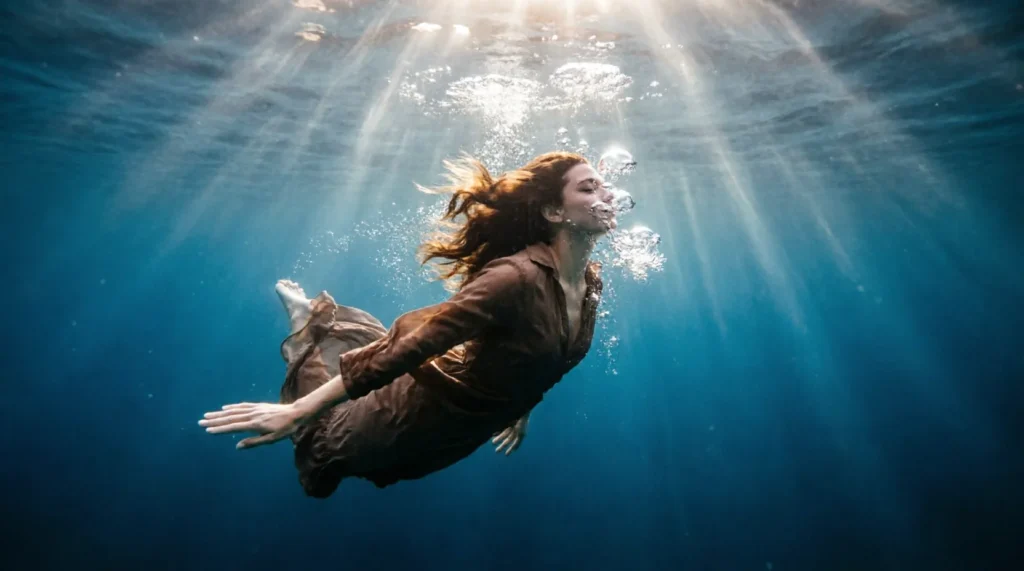
When you search for metaphors for drowning in water, you are usually looking for similes that capture the heavy, suffocating panic of going under. The examples below are categorized by the specific type of emotional or physical submersion you need to convey, ready to be dropped directly into your manuscripts.
What is a simile?
A simile is a figure of speech that compares two different things using the words “like” or “as,” creating a direct bridge between the familiar and the abstract. While a metaphor for drowning might state “the ocean was a swallowing mouth,” a simile explicitly builds the comparison: “the water closed over him like a swallowing mouth.” According to Metaphor, this linguistic tool allows writers to map the structural or emotional qualities of one concept onto another, making the invisible visceral.
The Panic and Struggle
When a character is fighting for their life, the language needs to feel frantic, sharp, and exhausted. These similes focus on the violent resistance against the water.
- “like a trapped bird in a net” — “She thrashed against the current like a trapped bird in a net.” (frantic, desperate). The hard consonants in this phrase mimic the physical choking of panic.
- “like a moth in a rainstorm” — “He fought the undertow like a moth in a rainstorm.” (futile, fragile). This highlights the sheer size difference between the character and the environment.
- “like a hooked marlin” — “He tore at the surface like a hooked marlin.” (violent, exhausted). Skip the overused “fish on a hook” cliché; marlin implies a larger, more desperate battle.
- “like a candle in a gale” — “Her strength flickered and died like a candle in a gale.” (fading, overwhelmed). A great way to show the exact moment a character gives up the physical fight.
- “like a rat in a sinking ship” — “He scrambled for air like a rat in a sinking ship.” (grim, survivalist). This strips away any dignity from the struggle, reducing the character to pure instinct.
- “like a mayfly in a downpour” — “He battered against the waves like a mayfly in a downpour.” (insignificant, relentless). Use this when you want to emphasize how uncaring the ocean is to the human fighting it.
The Surrender and Sinking
Not every drowning scene is a thrashing battle. Sometimes, the most powerful moments are when a character simply lets go. These similes capture the quiet, heavy inevitability of sinking.
- “like a stone in a well” — “He stopped fighting and sank like a stone in a well.” (heavy, final). The sibilance in ‘stone’ and ‘sank’ slows the reader’s breath, mimicking the exhale of surrender.
- “like a dropped coin” — “She slipped beneath the surface like a dropped coin.” (quick, silent). This works beautifully for a sudden, unexpected submersion where there is no time to struggle.
- “like a shadow at dusk” — “His consciousness faded like a shadow at dusk.” (gradual, quiet). Perfect for describing the mental fade-out that happens right before losing consciousness.
- “like a waterlogged hull” — “The boat of his mind went under like a waterlogged hull.” (inevitable, structural). A slightly more complex image that treats the character’s sanity or will to live as a physical vessel.
- “like a leaf in still water” — “She drifted down like a leaf in still water.” (peaceful, resigned). Use this for a scene where the character finds a strange, eerie calm in their fate.
- “like a swallowed secret” — “He went under like a swallowed secret.” (hidden, permanent). This adds a layer of thematic weight, suggesting the drowning will never be spoken of again.
The Sensory Deprivation
Drowning isn’t just about lack of air; it’s about the complete loss of the outside world. These similes focus on the muffled, disorienting experience of being submerged.
- “like a sealed jar” — “The world went quiet like a sealed jar.” (muffled, isolated). This instantly communicates the sudden, thick silence that falls when the head goes under.
- “like a radio tuned to static” — “The voices above sounded like a radio tuned to static.” (distorted, distant). This grounds the abstract loss of hearing in a modern, universally understood mechanical failure.
- “like a dream upon waking” — “The surface world dissolved like a dream upon waking.” (slipping away, intangible). Ideal for describing the visual blurring that happens as the eyes struggle to focus underwater.
- “like a photograph left in the rain” — “His memories blurred like a photograph left in the rain.” (fading, ruined). A poignant way to describe the final, fragmented thoughts of a drowning character.
- “like a voice in a wind tunnel” — “Her screams were like a voice in a wind tunnel.” (hollow, swallowed). Use this when describing the experience from the perspective of someone on the surface hearing the victim.
- “like a screen going black” — “The light above him shrank like a screen going black.” (technological, abrupt). A slightly anachronistic but highly effective image for modern fiction.
The Emotional Weight
Often, writers use drowning to describe grief, debt, or overwhelming anxiety. These similes translate physical submersion into emotional burdens.
- “like a heavy wool coat” — “Grief pulled him down like a heavy wool coat.” (burdensome, dragging). Wool absorbs water and becomes lethally heavy; this simile works because it turns an abstract emotion into a physical, deadly garment.
- “like a rusted anchor” — “Regret dragged at her ankles like a rusted anchor.” (corrosive, binding). The word ‘rusted’ implies that this emotional burden has been there a long time and is now impossible to remove.
- “like a tide coming in” — “The panic rose in his chest like a tide coming in.” (relentless, natural). This captures the slow, unstoppable buildup of an anxiety attack.
- “like a flood in a valley” — “Sorrow filled the room like a flood in a valley.” (expansive, consuming). Use this when the emotion doesn’t just affect the character, but completely alters the atmosphere around them.
- “like a cold current” — “She was pulled under by a cold current of guilt.” (chilling, invisible). This works well for sudden, unexpected waves of emotion that catch the character off guard.
- “like a swallowed ocean” — “He carried his trauma like a swallowed ocean.” (vast, internalized). A powerful image for a character who is functioning on the surface but internally drowning.
The Physical Sensation
When you need to describe the actual, biological reality of the act, you need similes that focus on pressure, temperature, and the failure of the body.
- “like a vice around the chest” — “The pressure built like a vice around the chest.” (crushing, tight). This accurately describes the diaphragm spasming as it tries to pull in water.
- “like inhaling needles” — “The water hit his lungs like inhaling needles.” (sharp, agonizing). A brutal, sharp image that leaves no doubt about the pain of the final breath.
- “like a block of ice” — “The cold seized her muscles like a block of ice.” (paralyzing, sudden). Essential for cold-water drowning scenes where hypothermia sets in before asphyxiation.
- “like a stretched drum” — “His eardrums throbbed like a stretched drum.” (pulsing, painful). A highly specific sensory detail that adds immediate physical realism to the scene.
- “like a plumb line” — “He fell through the water column like a plumb line.” (straight, gravity-bound). Use this for a character who has lost all buoyancy and is dropping straight down.
- “like a squeezed sponge” — “The last of his air escaped like a squeezed sponge.” (forced, emptying). A visceral way to describe the involuntary exhalation that happens right before the lungs fill.
How to write your own drowning in water simile
In my workshops, students often freeze when asked to write original figurative language. The trick is to break the process down into three simple steps.
First, identify the specific physical or emotional sensation you want to convey. Are you focusing on the cold, the lack of air, the panic, or the silence? Second, find an object or scenario from everyday life that shares that exact quality. If you’re focusing on the lack of air, think of a vacuum, a sealed room, or a crushed box. Third, draft the comparison using “like” or “as,” then read it aloud to check the rhythm and ensure it doesn’t sound clunky.
Let’s look at a worked example. Suppose you want to describe the exact moment lake water enters a character’s nose. The sensation is sharp, burning, and deeply invasive. You might initially think of “swallowing a lemon” (too culinary) or “breathing in smoke” (too fiery). Instead, think about cold, sharp things. How about crushed ice? Your draft becomes: “The lake water hit his sinuses like inhaling crushed ice.” It is specific, painful, and instantly understandable.
Frequently Asked Questions
What is the difference between a metaphor and a simile for drowning? A simile explicitly compares two things using “like” or “as” (e.g., “the water was like a heavy blanket”), while a metaphor states that one thing is another (e.g., “the water was a heavy blanket”). Both are effective, but similes often feel more grounded in physical reality.
How do I avoid clichés when writing about drowning? Avoid phrases like “like a fish out of water” or “sank like a stone” unless you are subverting them. It helps to remember that real drowning is rarely the dramatic, thrashing, screaming event seen in movies. According to Drowning, the actual instinctive drowning response is largely silent, with the head tilted back and the mouth at water level. Writing your similes to reflect this quiet, upright struggle will immediately set your work apart from Hollywood tropes.
Can similes for drowning be used for non-physical situations? Absolutely. In fact, some of the most powerful uses of these similes are in describing grief, overwhelming debt, or severe anxiety. The key is to ensure the emotional weight matches the physical weight of the water.
What is the most effective sense to target in these similes? While sight is important, sound and physical pressure are often more effective. Because vision is usually the first sense to blur and fail underwater, describing the muffled acoustics or the crushing pressure on the chest and ears creates a much more immersive experience for the reader.

Brian Walker is an esteemed linguist with a Ph.D. in Language and Literature from Stanford University. Over the past 20 years, Brian has dedicated his research to understanding the impact of figurative language on communication and literature. His extensive body of work includes scholarly articles that have been published in numerous academic journals. Brian’s fascination with similes emerged during his doctoral studies, where he examined their role in enhancing rhetorical persuasion and emotional resonance. As a contributor to VividSimiles, he writes detailed analyses on the historical evolution of similes and their varied applications across different cultures and languages. Brian’s articles are known for their depth and clarity, bridging the gap between academic research and practical application. He is committed to enlightening readers about the intricacies of language and the beauty of well-crafted similes.