

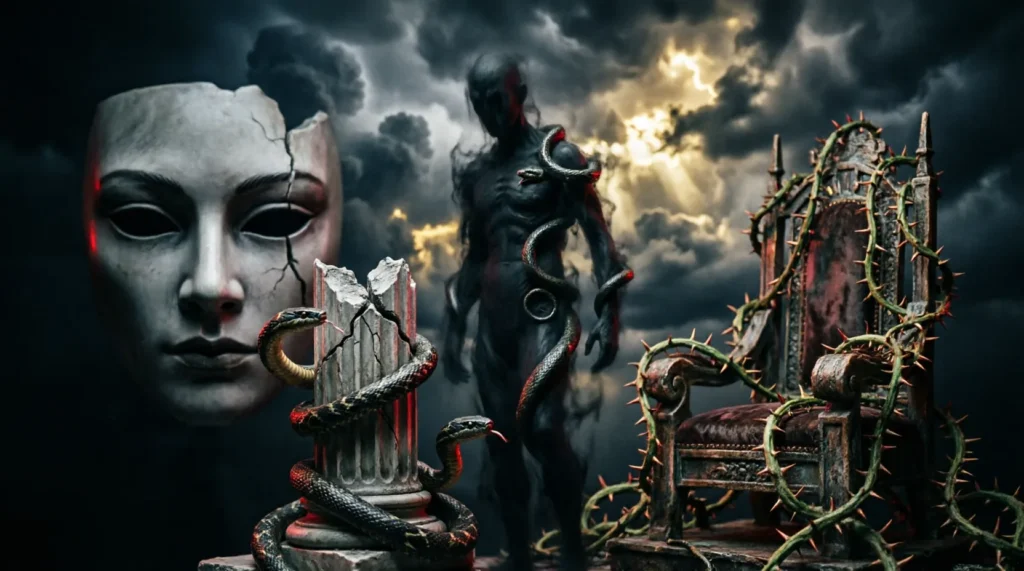
When you are crafting an antagonist, the right comparison can do more heavy lifting than three paragraphs of exposition. A sharp metaphor to describe a villain instantly communicates their threat level, their moral rot, or their chilling charisma without slowing down your narrative pace. The examples below are categorized by the specific type of evil they represent, giving you a toolkit to match the tone of your scene. Use these as starting points, then tweak them to fit the unique voice of your character.
What Is a Metaphor?
Before we dive into the dark comparisons, it helps to clarify exactly what we are building. A metaphor is a figure of speech that describes an object or action in a way that isn’t literally true but helps explain an idea or make a comparison Source: Metaphor. Unlike a simile, which uses “like” or “as” to compare two things, a metaphor states that one thing is another. For example, saying a villain is “a snake” is a metaphor; saying they are “like a snake” is a simile. Both are powerful, but metaphors often carry more weight and immediacy because they collapse the distance between the character and the image. When you want to define a character’s essence rather than just their appearance, metaphors are your best tool for concise, impactful description Source: Describe.
The Cold and Calculating Mastermind
These metaphors work best for villains who rely on intellect, manipulation, and long-term planning rather than brute force. They suggest a lack of empathy and a terrifying precision.
- “He was a chess player who saw people as pawns.” — “The CEO smiled, knowing he was a chess player who saw people as pawns.” (detached, strategic)
- “Her mind was a steel trap.” — “Don’t try to lie to her; her mind was a steel trap.” (unyielding, intelligent)
- “He was a spider weaving a web of lies.” — “Quietly, he was a spider weaving a web of lies around the investigation.” (patient, predatory)
- “She was a glacier, slow but unstoppable.” — “The corporation was a glacier, slow but unstoppable in its destruction of the town.” (inevitable, cold)
- “His heart was a ledger of debts.” — “He never forgot a slight; his heart was a ledger of debts.” (calculating, vengeful)
- “She was a surgeon cutting out the weak.” — “With cold efficiency, she was a surgeon cutting out the weak from her organization.” (precise, cruel)
Craft Note: The “chess player” metaphor is a classic for a reason—it immediately establishes hierarchy and intelligence. However, avoid overusing it unless you add a twist. Instead of just saying they see people as pawns, specify how they move them. Do they sacrifice them willingly? Do they value the queen above all else? Specificity turns a cliché into a character trait.
The Chaotic and Destructive Force
Use these when your villain is an agent of chaos, violence, or natural disaster. These comparisons emphasize raw power, unpredictability, and the aftermath of their actions.
- “He was a hurricane in a suit.” — “The boardroom fell silent as he entered; he was a hurricane in a suit.” (volatile, contained energy)
- “She was a wildfire consuming everything.” — “Her ambition was a wildfire consuming everything in its path.” (unstoppable, destructive)
- “He was a bomb waiting for a spark.” — “Keep your voice down; he was a bomb waiting for a spark.” (tense, dangerous)
- “Her rage was a tidal wave.” — “When she lost control, her rage was a tidal wave that drowned reason.” (overwhelming, natural force)
- “He was a wrecking ball swinging blind.” — “He didn’t care who got hurt; he was a wrecking ball swinging blind.” (reckless, violent)
- “She was a storm front bringing darkness.” — “The sky didn’t change, but she was a storm front bringing darkness.” (ominous, atmospheric)
Craft Note: Natural disaster metaphors are effective because they remove agency from the villain in a terrifying way—they aren’t just choosing to be evil; they are a force of nature. This makes them harder to reason with. The “hurricane in a suit” works well because it juxtaposes the civilized (suit) with the primal (hurricane), creating immediate tension.
The Deceptive and Charming Traitor
These metaphors are perfect for villains who hide in plain sight. They focus on the gap between appearance and reality, emphasizing betrayal and hidden danger.
- “He was a wolf in sheep’s clothing.” — “Trust him at your peril; he was a wolf in sheep’s clothing.” (classic, deceptive)
- “She was a poisoned apple.” — “Her offer looked sweet, but she was a poisoned apple.” (tempting, deadly)
- “He was a mirror reflecting what you wanted to see.” — “He had no true self; he was a mirror reflecting what you wanted to see.” (manipulative, empty)
- “She was a velvet glove over an iron fist.” — “Her kindness was a velvet glove over an iron fist.” (soft exterior, hard interior)
- “He was a shadow wearing a smile.” — “Even in the light, he was a shadow wearing a smile.” (unsettling, fake)
- “She was a siren song leading ships to rocks.” — “His promise was a siren song leading ships to rocks.” (alluring, disastrous)
Craft Note: The “wolf in sheep’s clothing” is arguably the most overused metaphor in fiction. I advise my students to skip it unless they are writing a fable or intentionally invoking fairy tale tropes. Instead, try the “mirror” metaphor. It suggests a deeper psychological horror—the villain has no identity of their own and only exists to manipulate others. That is far more disturbing than simple disguise.
The Corrupt and Decaying Influence
These comparisons work for villains who represent moral decay, institutional corruption, or a slow-rotting evil. They evoke sensations of sickness, rust, and stagnation.
- “He was rust eating through the foundation.” — “The mayor wasn’t loud, but he was rust eating through the foundation.” (slow, structural damage)
- “She was a cancer in the organization.” — “Her influence spread quietly; she was a cancer in the organization.” (insidious, deadly)
- “He was a mold spreading in the dark.” — “Neglect him, and he was a mold spreading in the dark.” (neglected, toxic)
- “She was a rot beneath the floorboards.” — “The house looked fine, but she was a rot beneath the floorboards.” (hidden, structural)
- “He was a stain that wouldn’t wash out.” — “His reputation was a stain that wouldn’t wash out.” (permanent, shameful)
- “She was a virus infecting the code.” — “One wrong click, and she was a virus infecting the code.” (digital, pervasive)
Craft Note: Decay metaphors are excellent for political thrillers or family dramas where the villain isn’t necessarily violent but is morally bankrupt. The key here is sensory language. Rust, mold, and rot all have distinct smells and textures. When you use these metaphors, describe the feeling they evoke in the protagonist. Does the air feel stale? Does the protagonist feel the need to scrub their hands after touching the villain?
How to Write Your Own Villain Metaphor
Creating a fresh metaphor is easier than you think if you follow a simple three-step process. First, identify the core trait of your villain (e.g., greed, silence, speed). Second, find an object or phenomenon in the real world that shares that trait. Third, strip away the “like” or “as” to make it a direct equation.
Worked Example:
- Trait: The villain is incredibly quiet and moves without being noticed.
- Object: A ghost? Too cliché. A shadow? Common. How about dust? Dust settles silently and covers everything eventually.
- Metaphor: “He was dust settling on the evidence.”
This method forces you to look beyond the obvious choices. Ask yourself: What does this villain feel like to be around? Do they feel like static electricity? Like a cold draft? Like a broken clock? The more specific the source domain, the more memorable the metaphor will be.
Frequently Asked Questions
What is the difference between a metaphor and a simile for a villain? A simile compares two things using “like” or “as” (e.g., “He was like a shark”), while a metaphor states that one thing is the other (e.g., “He was a shark”). Metaphors are generally stronger and more assertive, making them better for defining a villain’s core nature. Similes are useful for temporary comparisons or when you want to soften the impact slightly.
How do I avoid clichés when describing a villain? Avoid the most common animal comparisons (snake, wolf, lion) unless you can subvert them. Instead of comparing a villain to a generic “monster,” compare them to something specific and unexpected, like a malfunctioning machine, a specific weather pattern, or a household object that has turned dangerous. Specificity is the enemy of cliché.
Can a villain have positive metaphors? Yes, especially if they are charismatic or believed to be a hero by some characters. You might describe a tyrant as “a lighthouse guiding the ship,” even if the lighthouse is actually leading them into rocks. This creates dramatic irony and adds depth to the character’s public perception versus their private reality.
Where should I place metaphors in my story? Place them during introductions or key moments of realization. Don’t overload every paragraph with figurative language. One strong metaphor per scene is often enough to anchor the reader’s understanding of the villain. Save the most potent comparisons for the climax or the moment the protagonist fully understands the threat they face.

Justin Brown is a seasoned literary analyst with over 15 years of experience in the field of linguistics and literary studies. Holding a master’s degree in English Literature from the University of Chicago, Justin has devoted much of his career to exploring the nuances of similes and other forms of figurative language. His passion for deciphering the layers of meaning in literary works was kindled during his undergraduate years, where he was intrigued by the power of metaphorical language. Justin frequently contributes to VividSimiles by crafting engaging articles that decode the application of similes in both classical and contemporary literature. His insightful analyses help readers grasp the beauty and complexity of figurative expressions, making literature more accessible to all. In addition to writing, Justin conducts workshops for aspiring writers, nurturing their abilities to use language vividly and effectively.