

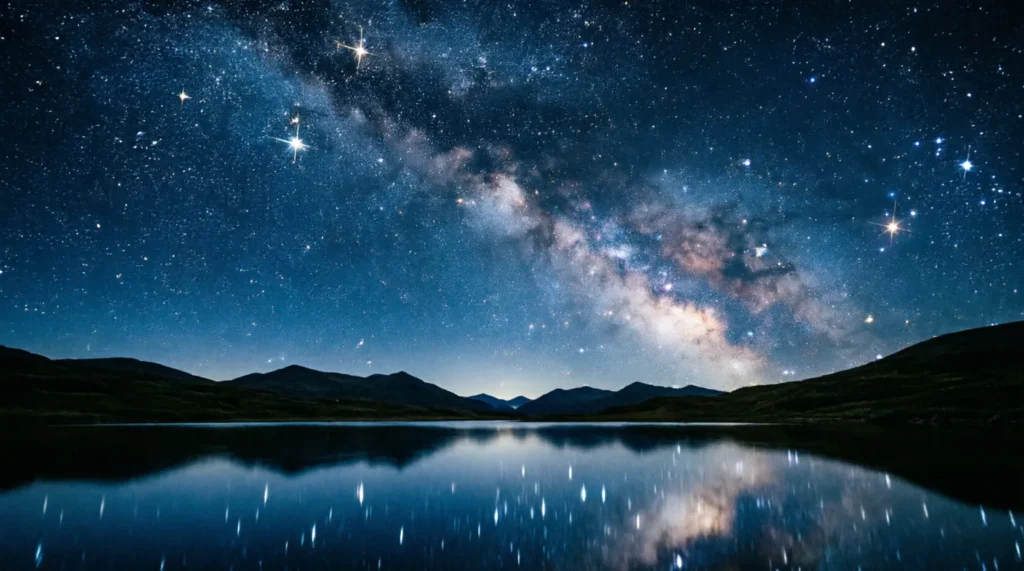
When you’re trying to capture the magic of a starlit sky, a well-chosen simile can do what plain description never will—it transports your reader straight to that moment of wonder. The similes below are organized by mood and effect, each demonstrated in a real sentence so you can see exactly how it works and steal it for your own writing tonight.
What Is a Simile?
A simile is a figure of speech that directly compares two different things using “like” or “as” to create a vivid mental image. Unlike a metaphor, which states that one thing is another (“the stars are diamonds”), a simile maintains the distinction while drawing the comparison (“the stars are like diamonds”). This small word makes all the difference—it invites the reader into the comparison rather than demanding they accept it as truth, which often makes similes feel more accessible and less precious in creative writing.
Brilliant and Dazzling: Similes for Intense Starlight
When the night sky is exceptionally clear and the stars burn with unusual intensity, you need comparisons that capture that brilliant, almost overwhelming brightness.
“like diamonds scattered across black velvet” — “The desert sky stretched above us, the stars like diamonds scattered across black velvet.” (luxurious, vivid) Craft note: This one works because it pairs a precious, hard object with soft fabric—the contrast creates tactile richness beyond just visual sparkle.
“as bright as spilled salt on dark stone” — “From the mountaintop, the stars appeared as bright as spilled salt on dark stone.” (sharp, high-contrast)
“like fireflies frozen in amber” — “The ancient stars hung in the sky like fireflies frozen in amber, preserved for eternity.” (preserved, timeless)
“as brilliant as shattered glass catching sunlight” — “After the storm cleared, the stars emerged as brilliant as shattered glass catching sunlight.” (dangerous beauty)
“like a ceiling of glittering sequins” — “The planetarium dome showed stars like a ceiling of glittering sequins, but the real thing is so much better.” (theatrical, artificial)
“as piercing as ice crystals” — “The winter stars shone as piercing as ice crystals, cold and sharp against the darkness.” (cold, crisp)
“like white-hot needles” — “At high altitude, the stars burned like white-hot needles stitching the sky together.” (intense, painful beauty) Craft note: The verb “stitching” does heavy lifting here—it transforms static points of light into active agents creating something.
“as radiant as a jeweler’s display case” — “The clear autumn night revealed stars as radiant as a jeweler’s display case.” (precious, curated)
My take: “Diamonds on black velvet” is the most overused simile in this category—your readers have seen it a thousand times. The “white-hot needles” comparison is far stronger because it adds temperature and action, not just sparkle.
Distant and Mysterious: Similes for Remote Starlight
Sometimes stars feel unreachable and enigmatic, their light traveling across impossible distances to reach our eyes. These similes capture that cosmic remove.
“like ancient lanterns hung by forgotten hands” — “The stars wheeled overhead like ancient lanterns hung by forgotten hands.” (mysterious, historical)
“as distant as memories from another life” — “Looking at those stars felt as distant as memories from another life, familiar but unreachable.” (nostalgic, melancholic)
“like eyes watching from across an ocean” — “The stars blinked like eyes watching from across an ocean, aware but separated by impossible distance.” (sentient, lonely)
“as remote as whispers from the edge of the universe” — “Each star burned as remote as whispers from the edge of the universe.” (faint, vast)
“like signals from dead civilizations” — “We gazed upward at stars like signals from dead civilizations, their light outliving their senders.” (haunting, scientific) Craft note: This one carries real weight because, according to Stars on Wikipedia, we’re literally seeing light from stars that may no longer exist—the simile isn’t just poetic, it’s astronomically accurate.
“as unreachable as tomorrow’s sunrise” — “Her dreams seemed as unreachable as tomorrow’s sunrise, constant but always ahead of us.” (philosophical, bittersweet)
“like questions the sky will never answer” — “The stars hung there like questions the sky will never answer, beautiful in their silence.” (contemplative, open-ended)
Gentle and Soothing: Similes for Soft Starlight
Not all starlit nights are brilliant and blazing. Sometimes the stars offer a softer, more comforting presence—perfect for these gentler comparisons.
“like a dusting of sugar on dark frosting” — “The faint stars appeared like a dusting of sugar on dark frosting, delicate and sweet.” (cozy, domestic)
“as soft as a lullaby hummed in the dark” — “The stars twinkled as soft as a lullaby hummed in the dark, calming and familiar.” (nurturing, peaceful)
“like breath fogging a windowpane” — “The dim stars showed like breath fogging a windowpane, temporary and fragile.” (ephemeral, intimate)
“as gentle as a mother’s hand on a fevered brow” — “The starlight fell as gentle as a mother’s hand on a fevered brow, cool and reassuring.” (comforting, protective)
“like silver fish swimming in deep water” — “The stars moved across the sky like silver fish swimming in deep water, fluid and silent.” (graceful, natural) For more, see Describe.
“as calming as waves on a moonlit shore” — “Watching the stars was as calming as waves on a moonlit shore, rhythmic and endless.” (meditative, cyclical)
“like a blanket of tiny night-lights” — “The children’s tent showed stars like a blanket of tiny night-lights, keeping darkness at bay.” (childlike, safe) Craft note: The specificity of “children’s tent” grounds this in a real scene—always better than abstract “various types of writing” vagueness.
Dynamic and Dancing: Similes for Moving or Twinkling Stars
Stars may be fixed in space, but atmospheric effects make them dance and shimmer. These similes capture that movement.
“like dancers on a cosmic stage” — “The stars twirled like dancers on a cosmic stage, performing their ancient ballet.” (theatrical, elegant)
“as restless as moths around a flame” — “The stars flickered as restless as moths around a flame, never still for long.” (agitated, alive)
“like a school of minnows changing direction” — “The stars shifted like a school of minnows changing direction, moving as one organism.” (collective, fluid)
“as playful as children jumping rope” — “Through the telescope, the stars jumped as playful as children jumping rope, bouncing in the atmosphere.” (joyful, energetic)
“like candle flames in a drafty room” — “The horizon stars wavered like candle flames in a drafty room, unstable and uncertain.” (fragile, trembling)
“as lively as popcorn in a hot pan” — “New stars appeared as lively as popcorn in a hot pan, popping into view one by one.” (sudden, abundant) Craft note: This works because it engages multiple senses—you can hear popcorn popping, not just see it. Multi-sensory similes always hit harder.
“like a heartbeat visible in the sky” — “The pulsing star throbbed like a heartbeat visible in the sky, the universe made alive.” (vital, organic)
Patterned and Purposeful: Similes for Constellations and Arrangements
When stars form recognizable patterns or seem deliberately placed, these similes emphasize order and intention.
“like connect-the-dots waiting to be solved” — “The constellations stretched like connect-the-dots waiting to be solved, inviting participation.” (interactive, playful)
“as organized as beads on a string” — “The stars lined up as organized as beads on a string, deliberate and sequential.” (ordered, crafted)
“like a map drawn in light” — “The stars formed like a map drawn in light, guiding travelers home.” (navigational, hopeful)
“as deliberate as punctuation in a sentence” — “The bright stars stood as deliberate as punctuation in a sentence, giving structure to the darkness.” (grammatical, meaningful)
“like stitches holding the sky together” — “The stars appeared like stitches holding the sky together, preventing it from unraveling.” (functional, essential)
“as arranged as instruments in an orchestra” — “The stars sat as arranged as instruments in an orchestra, each in its proper place.” (harmonious, prepared)
“like a code waiting to be cracked” — “The patterns emerged like a code waiting to be cracked, full of hidden meaning.” (mysterious, intellectual) Craft note: This simile works particularly well in college essays or personal statements where you’re discussing problem-solving or discovery—it shows analytical thinking while maintaining poetic beauty.
How to Write Your Own Star Simile
Creating original similes for stars isn’t as hard as you might think. Follow this simple three-step process:
Step 1: Identify the specific quality you want to emphasize—is it the brightness, the distance, the pattern, the color, or the emotional effect?
Step 2: Brainstorm objects or experiences from everyday life that share that quality. Don’t reach for “diamonds” or “jewels”—think about your kitchen, your childhood, your commute, your hobbies.
Step 3: Test it by saying it aloud. If it sounds natural and creates an immediate image, you’ve got a winner.
Worked example: Let’s say you want to capture how stars appear gradually as darkness falls. Quality: gradual emergence. Brainstorm: ink spreading in water, guests arriving at a party, flowers opening. Final simile: “The stars appeared like guests arriving at a party, a few at first, then more and more until the sky was crowded.”
Frequently Asked Questions
What makes a star simile effective versus clichéd? An effective simile surprises the reader with an unexpected but apt comparison, while a clichéd one relies on worn-out imagery like “diamonds in the sky.” The best similes draw from specific, concrete experiences rather than generic “beautiful” objects. If you can picture a real person in a real place using your comparison, it’s probably fresh enough to use.
Can I mix metaphors and similes when describing stars? Yes, but do it intentionally and sparingly. You might start with a simile (“the stars were like scattered salt”) and then extend it metaphorically (“the sky’s careless seasoning”). The danger comes when you switch between incompatible images rapidly—that creates confusion rather than richness. Stick with one dominant image per paragraph.
How do I describe stars without using any similes at all? Focus on precise, concrete details: their actual colors (not just “white” but blue-white, amber, red), their positions relative to landmarks, the way they affect your vision or mood, the scientific reality of their distance and age. Sometimes direct observation beats comparison. That said, similes remain the fastest way to create emotional resonance in limited space, like song lyrics or flash fiction.
Are there star similes appropriate for different writing contexts? Absolutely. A eulogy might use “like ancestors watching over us,” while a science fiction story could employ “like fusion reactors scattered across the void.” A romance might feature “like promises whispered in darkness,” whereas a horror piece could use “like eyes that never close.” Always match your simile’s tone to your genre’s expectations—what comforts in one context might terrify in another.

Jennifer Martinez is a creative writer and educator with a deep love for similes and figurative language. With a degree in Creative Writing from New York University and over a decade of teaching experience in high schools, Jennifer has a unique ability to explain complex concepts in simple terms. Her journey into the world of figurative language began with her own writing, where she noticed how similes and metaphors could transform the mundane into the extraordinary. At VividSimiles, Jennifer shares her expertise by writing thought-provoking essays and guides on how similes enhance storytelling. Her content often focuses on helping writers of all levels hone their style by incorporating figurative language effectively. In her spare time, Jennifer enjoys reading poetry and experimenting with new forms of expression in her own work.