

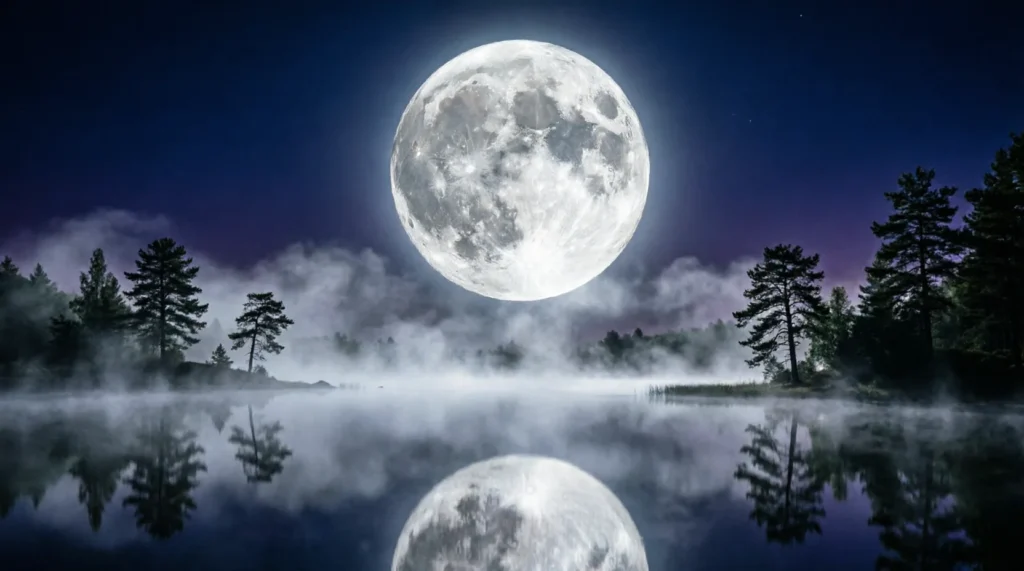
When the moon glows, it transforms the night into something worthy of description, but finding the right comparison can be tricky. The similes below are organized by mood and intensity so you can instantly find the perfect match for your scene, whether you’re writing a love letter, a horror story, or a poem about longing. Each example shows the simile in action so you can see exactly how it works in context.
Gentle and Romantic Glow
These similes capture the moon’s tender, intimate side—perfect for love scenes, quiet reflections, or moments of peace.
“like a pearl resting on black velvet” — “The moon glowed like a pearl resting on black velvet, precious and still.” (elegant, luxurious)
- Craft note: The alliteration of “pearl” and “pearl” creates a soft, rolling sound that mirrors the gentle light itself.
“like a nightlight left on for a child” — “The moon glowed like a nightlight left on for a child, reassuring in its constancy.” (comforting, protective)
“like honey spreading across dark bread” — “The moon glowed like honey spreading across dark bread, warm and slow.” (nourishing, sensual)
- Craft note: This works because it engages taste and touch, not just sight—making the description multi-sensory.
“like a lover’s promise whispered in the dark” — “The moon glowed like a lover’s promise whispered in the dark, faint but certain.” (intimate, hopeful)
“like a lullaby hummed by the sky” — “The moon glowed like a lullaby hummed by the sky, soft enough to soothe.” (calming, maternal)
“like the last ember of a dying fire” — “The moon glowed like the last ember of a dying fire, fragile but persistent.” (tender, vulnerable)
“like a candle in a cathedral window” — “The moon glowed like a candle in a cathedral window, sacred and distant.” (reverent, spiritual)
“like a blush on midnight’s cheek” — “The moon glowed like a blush on midnight’s cheek, shy and unexpected.” (delicate, charming)
In my workshops, students often reach for “like a diamond” first, but that’s become so overused it loses impact. The pearl comparison above is stronger because it suggests rarity without the harsh sparkle—diamonds cut, but pearls glow from within.
Mysterious and Ethereal Glow
When the moon feels otherworldly, supernatural, or just slightly unsettling, these similes capture that uncanny quality.
“like a ghost’s whisper given form” — “The moon glowed like a ghost’s whisper given form, visible but intangible.” (haunting, spectral)
“like a secret the night was finally telling” — “The moon glowed like a secret the night was finally telling, luminous with revelation.” (enigmatic, knowing)
- Craft note: Personifying the night as a confidant adds narrative tension—readers want to know what the secret is.
“like a dream you can’t quite remember” — “The moon glowed like a dream you can’t quite remember, familiar yet elusive.” (nostalgic, vague)
“like an eye watching from another world” — “The moon glowed like an eye watching from another world, ancient and unknowable.” (ominous, cosmic)
“like magic caught in mid-spell” — “The moon glowed like magic caught in mid-spell, suspended and potent.” (mystical, charged)
“like a riddle written in light” — “The moon glowed like a riddle written in light, beautiful but indecipherable.” (intellectual, puzzling)
“like a memory that isn’t yours” — “The moon glowed like a memory that isn’t yours, vivid but unclaimed.” (uncanny, displaced)
“like a door left ajar in the dark” — “The moon glowed like a door left ajar in the dark, inviting and dangerous.” (suspenseful, liminal)
According to the article on Simile, the most effective comparisons create unexpected connections that reveal something new about the subject. The “door left ajar” simile works because it transforms the moon from a celestial object into a threshold—suddenly it’s not just light, but a passage somewhere.
Melancholic and Lonely Glow
For scenes of loss, longing, or isolation, these similes emphasize the moon’s solitary nature and its association with night’s quiet sadness.
“like a tear the sky couldn’t hold” — “The moon glowed like a tear the sky couldn’t hold, silver with sorrow.” (grief-stricken, vulnerable)
“like a memory that refuses to fade” — “The moon glowed like a memory that refuses to fade, persistent and painful.” (haunting, stubborn)
“like a goodbye no one heard” — “The moon glowed like a goodbye no one heard, silent and complete.” (resigned, final)
“like a wish made on a falling star” — “The moon glowed like a wish made on a falling star, beautiful but already gone.” (wistful, ephemeral)
- Craft note: This layers two celestial images—the moon and the falling star—creating a sense of double loss.
“like a heartache given light” — “The moon glowed like a heartache given light, visible but untouchable.” (aching, distant)
“like a prayer sent into emptiness” — “The moon glowed like a prayer sent into emptiness, faithful but unanswered.” (devout, forlorn)
“like the space where someone should be” — “The moon glowed like the space where someone should be, defined by absence.” (lonely, hollow)
“like a song with no one to hear it” — “The moon glowed like a song with no one to hear it, full of unshared beauty.” (unappreciated, pure)
I tell my students that melancholy similes work best when they suggest absence rather than just sadness. The “space where someone should be” is more powerful than “like a sad face” because it makes the reader feel the emptiness, not just observe it.
Powerful and Dramatic Glow
When the moon dominates the sky, commanding attention or signaling something momentous, these similes emphasize its strength and presence.
“like a beacon calling ships home” — “The moon glowed like a beacon calling ships home, insistent and guiding.” (authoritative, protective)
“like a king’s crown on the brow of night” — “The moon glowed like a king’s crown on the brow of night, regal and unquestioned.” (majestic, sovereign)
“like the aftermath of a supernova” — “The moon glowed like the aftermath of a supernova, violent beauty made still.” (cosmic, intense)
- Craft note: Juxtaposing destruction (“supernova”) with stillness creates tension—this isn’t peaceful light, it’s light that survived catastrophe.
“like a warrior’s shield raised high” — “The moon glowed like a warrior’s shield raised high, defiant and bright.” (courageous, protective)
“like a goddess opening her eye” — “The moon glowed like a goddess opening her eye, divine and aware.” (mythic, omniscient)
“like a force that cannot be ignored” — “The moon glowed like a force that cannot be ignored, demanding witness.” (commanding, inevitable)
“like a spotlight on an empty stage” — “The moon glowed like a spotlight on an empty stage, dramatic and expectant.” (theatrical, anticipatory)
“like a declaration written in the sky” — “The moon glowed like a declaration written in the sky, bold and permanent.” (assertive, monumental)
Avoid “like a lightbulb” or “like a lamp”—these domestic comparisons shrink the moon’s power. The supernova simile above is one of my favorites because it suggests the moon isn’t just reflecting light, but contains the energy of stellar death.
Natural and Organic Glow
These similes root the moon’s light in the natural world, emphasizing its connection to earth, water, and living things.
“like dew on a spider’s web” — “The moon glowed like dew on a spider’s web, delicate and intricate.” (fragile, precise)
“like a ripe fruit ready to be picked” — “The moon glowed like a ripe fruit ready to be picked, full and luminous.” (abundant, inviting)
“like a flower opening at dawn” — “The moon glowed like a flower opening at dawn, natural and inevitable.” (organic, graceful)
“like a river reflecting the sky” — “The moon glowed like a river reflecting the sky, fluid and responsive.” (adaptive, mirroring)
“like a seed breaking through soil” — “The moon glowed like a seed breaking through soil, persistent and new.” (determined, emergent)
- Craft note: This unexpected pairing—moon as seed—suggests growth and potential rather than just illumination.
“like a leaf catching sunlight” — “The moon glowed like a leaf catching sunlight, translucent and alive.” (vibrant, delicate)
“like mist rising from a lake” — “The moon glowed like mist rising from a lake, soft and shape-shifting.” (elusive, atmospheric)
“like bark on an ancient tree” — “The moon glowed like bark on an ancient tree, weathered and enduring.” (timeless, textured)
The Wikipedia article on Glowed Up discusses how light transforms perception, and these organic similes show that transformation happening in nature itself—the moon doesn’t just shine, it ripens, opens, rises, and breaks through.
How to Write Your Own Moon Simile
Creating original similes is a skill you can develop with practice. Here’s my three-step method that I use with students:
Step 1: Identify the specific quality of the moon’s glow you want to emphasize. Is it soft? Harsh? Steady? Flickering? Cold? Warm? Don’t just say “bright”—that’s too vague.
Step 2: Brainstorm objects or experiences that share that quality but aren’t obviously connected to the moon. If you’re describing cold light, don’t reach for “ice” or “snow”—those are expected. Try “like a scalpel” or “like a forgotten refrigerator light” instead.
Step 3: Test your simile by reading it aloud. Does it create an immediate image? Does it feel fresh, or does it sound like something you’ve read before?
Worked example: Let’s say you want to describe the moon as comforting. Expected comparison: “like a blanket.” Too cliché. Better: “like a hand on a fevered forehead”—still comforting, but more specific and tactile. Best: “like a hand on a fevered forehead, cool and certain”—now you’ve added rhythm and a second quality that deepens the image.
Frequently Asked Questions
What makes a moon simile effective? The best similes create unexpected connections that reveal something new about the moon. Instead of comparing it to other light sources (lamps, stars), compare it to emotions, textures, or actions. The goal is to make readers see the moon differently, not just confirm what they already know.
Should I use similes in formal writing? Yes, but sparingly. In academic or professional writing, one well-placed simile can illuminate a complex idea. In creative writing, you have more freedom, but avoid stacking multiple similes in one paragraph—that dilutes their impact. Choose the single strongest comparison for each moment.
How do I avoid clichéd moon similes? Steer clear of “like a diamond,” “like a pearl,” or “like a light in the darkness”—these are so overused they’ve lost meaning. Instead, ask yourself: what does this specific moon look like in this specific moment? A harvest moon in autumn glows differently than a winter moon at midnight. Specificity kills clichés.
Can I mix metaphors and similes about the moon? You can, but be careful. If you start with “the moon was a silver coin” (metaphor), don’t immediately follow with “it glowed like a beacon” (simile) unless you’re deliberately shifting perspective. Consistency in your imagery creates stronger, more cohesive writing.

Brian Walker is an esteemed linguist with a Ph.D. in Language and Literature from Stanford University. Over the past 20 years, Brian has dedicated his research to understanding the impact of figurative language on communication and literature. His extensive body of work includes scholarly articles that have been published in numerous academic journals. Brian’s fascination with similes emerged during his doctoral studies, where he examined their role in enhancing rhetorical persuasion and emotional resonance. As a contributor to VividSimiles, he writes detailed analyses on the historical evolution of similes and their varied applications across different cultures and languages. Brian’s articles are known for their depth and clarity, bridging the gap between academic research and practical application. He is committed to enlightening readers about the intricacies of language and the beauty of well-crafted similes.