

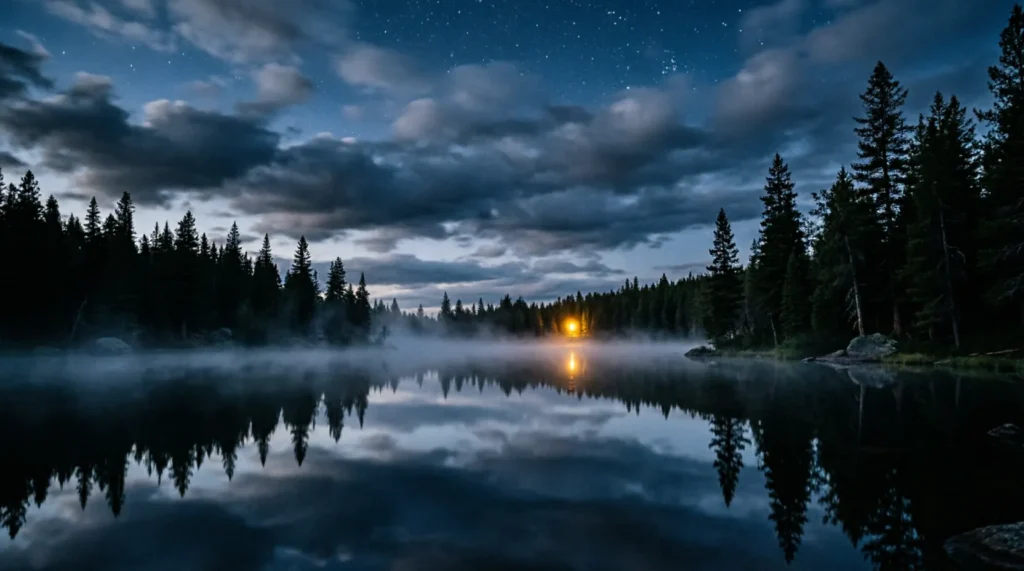
When you’re trying to capture the particular quality of darkness after sunset, a well-chosen simile can do what adjectives alone cannot—it creates an immediate sensory connection for your reader. The similes below are organized by the mood and atmosphere they create, each demonstrated in a complete sentence so you can see exactly how it functions in context. Whether you’re writing horror, romance, or literary fiction, you’ll find comparisons here that match the specific emotional texture you need.
Oppressive and Threatening Darkness
These similes work when the night itself feels like an antagonist, when darkness is something that presses down or closes in around your characters.
“as suffocating as a wool blanket soaked in tar” — “The forest at midnight was as suffocating as a wool blanket soaked in tar.” (claustrophobic, visceral)
Craft note: The specificity of “wool” and “tar” together creates both texture and smell, making this more effective than generic “heavy” comparisons.
“like being buried alive in wet cement” — “Outside, the storm had turned the night like being buried alive in wet cement.” (panicked, trapped)
“as complete as a tomb sealed for centuries” — “When the power failed, the darkness became as complete as a tomb sealed for centuries.” (absolute, ancient)
“like a predator’s mouth closing slowly” — “The shadows gathered at the edge of camp, like a predator’s mouth closing slowly.” (menacing, patient)
“as impenetrable as iron” — “She tried to scan the horizon, but the night was as impenetrable as iron.” (frustrating, solid)
“like drowning in ink” — “He opened his eyes underwater, the night like drowning in ink.” (disorienting, liquid)
Craft note: This works because it suggests both color and movement—the ink isn’t static, it’s actively overwhelming.
“as relentless as a siege” — “The darkness stretched on, as relentless as a siege.” (exhausting, military)
“like a noose tightening around the world” — “Dusk fell like a noose tightening around the world.” (violent, inescapable)
This is where I see students reach for “dark as night” itself—a tired cliché that tells us nothing. The similes above work because they introduce a second concrete image that carries its own emotional weight.
Mysterious and Unknown Darkness
Use these when the night conceals secrets or possibilities, when darkness suggests the unknown rather than pure threat.
“as unknowable as the bottom of the ocean” — “The alley stretched before them, as unknowable as the bottom of the ocean.” (vast, unexplored)
“like a question mark drawn in charcoal” — “The path ahead was like a question mark drawn in charcoal.” (uncertain, artistic)
Craft note: The “charcoal” detail matters—it’s erasable, smudged, imperfect, which mirrors the uncertainty better than “ink” would.
“as cryptic as a message in a dead language” — “The forest at midnight stood as cryptic as a message in a dead language.” (intellectual, ancient)
“like a locked room with no key” — “She stared into the yard, the night like a locked room with no key.” (frustrating, contained)
“as ambiguous as smoke” — “His future stretched before him, as ambiguous as smoke.” (shifting, unclear)
“like a puzzle with missing pieces” — “The conspiracy unfolded like a puzzle with missing pieces.” (incomplete, maddening)
“as obscure as a half-remembered dream” — “The events of that evening remained as obscure as a half-remembered dream.” (elusive, personal)
According to Simile, the power of this figure of speech lies in its ability to make the unfamiliar comprehensible by linking it to something concrete. These comparisons work because they take the abstract quality of “mysterious darkness” and ground it in tangible experiences—locked rooms, smoke, puzzles—that readers have actually encountered.
Peaceful and Comforting Darkness
Not all darkness threatens. Sometimes night brings relief, rest, or sanctuary. These similes capture that gentler side.
“as soft as worn velvet” — “The evening settled around them, as soft as worn velvet.” (comfortable, luxurious)
“like a cool hand on a fevered brow” — “After the desert heat, the night came like a cool hand on a fevered brow.” (relieving, nurturing)
Craft note: The tactile specificity here—temperature and touch—makes this more effective than visual-only comparisons.
“as gentle as a lullaby” — “Darkness fell as gentle as a lullaby.” (soothing, musical)
“like sinking into a deep bath” — “She welcomed the night like sinking into a deep bath.” (relaxing, immersive)
“as quiet as held breath” — “The forest at midnight was as quiet as held breath.” (anticipatory, delicate)
“like a curtain drawn against the world” — “Night fell like a curtain drawn against the world.” (protective, theatrical)
“as forgiving as sleep” — “The darkness came as forgiving as sleep.” (merciful, restorative)
“like being wrapped in shadow” — “He stepped outside, like being wrapped in shadow.” (intimate, personal)
The version my students always reach for first in this category is “dark as coal,” which is technically accurate but emotionally empty. Coal doesn’t feel like anything—it’s just a black rock. Compare that to “worn velvet,” which immediately suggests texture, temperature, and a history of use. That’s the difference between a simile that works and one that merely exists.
Beautiful and Poetic Darkness
These comparisons emphasize the aesthetic qualities of night, when darkness is something to be admired rather than endured.
“as elegant as a ballgown” — “The night draped over the city as elegant as a ballgown.” (sophisticated, formal)
“like polished obsidian” — “The lake at midnight shone like polished obsidian.” (reflective, precious)
Craft note: “Obsidian” does double duty here—it’s both black and reflective, capturing how night can be dark yet still show you something.
“as rich as dark chocolate” — “The evening air tasted as rich as dark chocolate.” (indulgent, sensory)
“like spilled ink on silk” — “Clouds moved across the moon like spilled ink on silk.” (fluid, artistic)
“as deep as a sapphire” — “The sky was as deep as a sapphire.” (valuable, profound)
“like a canvas waiting for stars” — “Night fell like a canvas waiting for stars.” (anticipatory, artistic)
“as smooth as black marble” — “The pond lay as smooth as black marble.” (solid, refined)
“like velvet stretched over the world” — “Darkness arrived like velvet stretched over the world.” (luxurious, complete)
When Describe something as complex as nighttime atmosphere, the choice of comparison object determines whether readers feel invited into the scene or pushed away. “Polished obsidian” invites curiosity; “dark as pitch” shuts it down.
Urban and Modern Darkness
City darkness differs fundamentally from natural darkness—these similes capture that manufactured, artificial quality.
“as artificial as a blacked-out screen” — “The blackout left the city as artificial as a blacked-out screen.” (unnatural, technological)
“like a power outage in the soul” — “His mood that evening was like a power outage in the soul.” (existential, modern)
“as manufactured as plastic” — “The club’s darkness felt as manufactured as plastic.” (fake, synthetic)
“like static on a dead channel” — “The void between buildings was like static on a dead channel.” (empty, electronic)
“as hollow as an abandoned warehouse” — “The night stretched on, as hollow as an abandoned warehouse.” (empty, industrial)
“like a monitor turned off” — “Sleep came like a monitor turned off.” (sudden, technological)
Natural and Primal Darkness
These work for wilderness settings, when darkness feels ancient and untouched by human hands.
“as old as the first cave” — “The darkness in the canyon was as old as the first cave.” (primordial, ancestral)
“like the inside of a wolf’s den” — “The forest floor at midnight was like the inside of a wolf’s den.” (wild, dangerous)
“as wild as untamed hair” — “The shadows twisted as wild as untamed hair.” (chaotic, natural)
“like the space between heartbeats” — “Silence fell like the space between heartbeats.” (brief, vital)
Craft note: This one is deceptively simple but powerful because it references something universal yet rarely noticed—the tiny darkness between beats.
“as ancient as stone” — “The night pressed down, as ancient as stone.” (timeless, heavy)
“like roots in deep earth” — “Darkness spread through the valley like roots in deep earth.” (organic, spreading)
How to Write Your Own Night Simile
Creating effective similes for darkness requires more than just finding something black. Follow this three-step process:
Step 1: Identify the emotional quality of the darkness you’re describing. Is it threatening? Comforting? Mysterious? Beautiful? Empty? The emotion matters more than the visual.
Step 2: Brainstorm objects or experiences that create that same emotion, regardless of color. Don’t limit yourself to dark things—a “cool hand on a fevered brow” isn’t dark, but it captures the relief of nighttime after a hot day.
Step 3: Test your comparison by asking: Does this introduce new sensory information? If your simile is “dark as night,” you’ve told us nothing. If it’s “dark as a sealed tomb,” you’ve added temperature, texture, and emotional resonance.
Worked example: Let’s say you’re writing about the darkness that falls after an argument. The emotion is heavy silence, not visual darkness. You might try: “The night between them was like a room where everyone has stopped speaking.” This works because it captures the emotional quality rather than just the visual fact.
Frequently Asked Questions
What makes a simile different from a metaphor when describing darkness?
A simile explicitly compares using “like” or “as” (“the night was like a blanket”), while a metaphor states the comparison as fact (“the night was a blanket”). Similes tend to feel more conversational and accessible; metaphors can feel more authoritative and poetic. Neither is inherently better—it depends on your voice and context.
How do I avoid clichés when writing about dark nights?
The test is simple: if you’ve heard the comparison in a pop song, greeting card, or young adult novel, it’s probably tired. “Dark as night,” “black as coal,” and “dark as pitch” have been used so extensively they’ve lost their impact. Instead, look for unexpected comparison objects that still make emotional sense.
Can I use similes for darkness in non-fiction writing?
Absolutely. Memoir, journalism, and even academic writing can benefit from strategic similes. The key is restraint—one well-placed comparison per scene or section is usually enough. In non-fiction, your similes should illuminate facts rather than decorate them.
Why do some darkness similes work better than others?
The strongest similes engage multiple senses and carry emotional weight beyond the visual. “Dark as a sealed tomb” works better than “dark as ink” because it suggests temperature (cold), texture (stone), sound (silence), and emotion (fear or reverence). The more dimensions your comparison object has, the more vivid your simile becomes.

Brian Walker is an esteemed linguist with a Ph.D. in Language and Literature from Stanford University. Over the past 20 years, Brian has dedicated his research to understanding the impact of figurative language on communication and literature. His extensive body of work includes scholarly articles that have been published in numerous academic journals. Brian’s fascination with similes emerged during his doctoral studies, where he examined their role in enhancing rhetorical persuasion and emotional resonance. As a contributor to VividSimiles, he writes detailed analyses on the historical evolution of similes and their varied applications across different cultures and languages. Brian’s articles are known for their depth and clarity, bridging the gap between academic research and practical application. He is committed to enlightening readers about the intricacies of language and the beauty of well-crafted similes.