

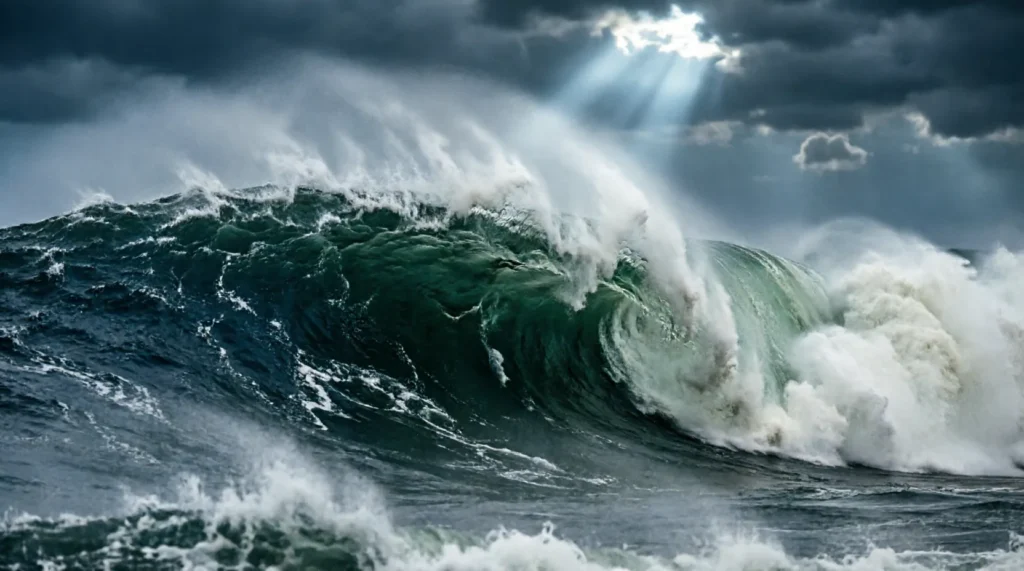
When you need to capture the raw power of a stormy sea, a well-chosen simile can do what plain description cannot—it connects the unfamiliar fury of churning waters to something your reader already knows in their bones. The similes below are organized by the specific quality of the storm you’re trying to convey, whether that’s its deafening roar, its chaotic movement, or its terrifying darkness. Use them as-is in your writing, or let them spark your own comparisons.
Power and Violence
These similes emphasize the sea’s destructive force and overwhelming strength. They work best when you need to show nature at its most unstoppable.
“like a sledgehammer smashing glass” — “The wave hit the pier like a sledgehammer smashing glass.” (brutal, sudden impact) Craft note: The hard consonants in “sledgehammer smashing glass” mimic the actual sound of impact—this one works because it’s as violent to say as it is to hear.
“as furious as a cornered beast” — “The ocean roared as furious as a cornered beast.” (primal, dangerous rage)
“like an angry god’s fist” — “The storm drove the waves forward like an angry god’s fist.” (mythic, overwhelming power)
“as relentless as a siege engine” — “The water battered the cliffs as relentless as a siege engine.” (mechanical, unstoppable force)
“like a thousand war drums” — “The surf pounded the shore like a thousand war drums.” (rhythmic, martial intensity) Craft note: This works because it gives the sea both sound and intention—war drums don’t just make noise, they signal attack.
“as violent as a riot” — “The chop was as violent as a riot.” (chaotic, human-scale destruction)
“like a wrecking ball” — “Each swell hit the seawall like a wrecking ball.” (deliberate, structural damage)
“as savage as a predator’s jaws” — “The undertow grabbed as savage as a predator’s jaws.” (personal threat, bodily danger)
Avoid this tired one: “like a raging bull” — it’s been used so often it’s lost all impact. Your readers’ eyes will glaze over.
Chaos and Confusion
When the stormy sea disorients and overwhelms, these similes capture that sense of losing control and direction.
“like a washing machine on spin cycle” — “The dinghy tossed like a washing machine on spin cycle.” (modern, relatable chaos)
“as confused as a dropped puzzle” — “The currents ran as confused as a dropped puzzle.” (fragmented, nonsensical movement)
“like a crowd fleeing disaster” — “The waves scattered like a crowd fleeing disaster.” (panicked, directionless motion)
“as tangled as earbuds in a pocket” — “The whitecaps churned as tangled as earbuds in a pocket.” (frustrating, knotted mess) Craft note: This everyday comparison works because everyone knows that specific frustration—immediate recognition creates instant understanding.
“like a shaken snow globe” — “The harbor looked like a shaken snow globe.” (contained chaos, visual confusion)
“as disordered as a raided beehive” — “The surface was as disordered as a raided beehive.” (agitated, swarming energy)
“like cards thrown in the air” — “The foam scattered like cards thrown in the air.” (random, unpredictable scatter)
“as jumbled as a landslide” — “The debris floated as jumbled as a landslide.” (catastrophic mixing)
Sound and Fury
A stormy sea is as much about what you hear as what you see. These similes focus on the auditory assault.
“like a freight train in a tunnel” — “The wind howled like a freight train in a tunnel.” (deafening, enclosed roar) Craft note: This is the version my students always reach for first when describing storm sound, and for good reason—it’s immediately recognizable and viscerally loud.
“as loud as a collapsing building” — “The crash was as loud as a collapsing building.” (catastrophic, structural noise)
“like a choir of demons” — “The gale sang like a choir of demons.” (supernatural, menacing harmony)
“as thunderous as artillery” — “The breakers hit as thunderous as artillery.” (military, explosive impact)
“like a thousand voices screaming” — “The surf roared like a thousand voices screaming.” (human agony, overwhelming chorus)
“as deafening as a jet engine” — “The storm was as deafening as a jet engine.” (modern, mechanical overwhelm)
“like a drum solo gone wrong” — “The rain hammered the deck like a drum solo gone wrong.” (rhythmic chaos, loss of control)
“as booming as cathedral bells” — “The waves struck as booming as cathedral bells.” (resonant, echoing power)
According to Wikipedia’s entry on Simile, effective similes create understanding by linking the unfamiliar to the familiar—which is why comparing ocean sounds to freight trains or jet engines works better than abstract descriptions. For more, see Describe.
Darkness and Danger
When you need to emphasize the threatening, ominous quality of a stormy sea, these similes lean into fear and foreboding.
“like a grave opening” — “The trough yawned like a grave opening.” (deathly, final darkness)
“as black as a drowned heart” — “The water looked as black as a drowned heart.” (emotional darkness, death) Craft note: This one borders on metaphor, but the “as…as” structure keeps it simile territory while adding emotional weight that pure description lacks.
“like a predator’s eye” — “The swell rose like a predator’s eye.” (watching, hunting menace)
“as ominous as a funeral bell” — “The foghorn sounded as ominous as a funeral bell.” (death-knock, inevitable doom)
“like a mouth full of knives” — “The reef waited like a mouth full of knives.” (hidden danger, tearing threat)
“as threatening as a raised weapon” — “The wave hung as threatening as a raised weapon.” (suspended violence, anticipation)
“like a trap springing shut” — “The current pulled like a trap springing shut.” (sudden, inescapable capture)
“as sinister as a locked room” — “The cove seemed as sinister as a locked room.” (concealed threat, claustrophobic danger)
Movement and Motion
These similes capture the specific ways a stormy sea moves—its rolling, crashing, churning physicality.
“like a herd of stampeding elephants” — “The swells charged like a herd of stampeding elephants.” (massive, unstoppable momentum)
“as jerky as a marionette” — “The boat danced as jerky as a marionette.” (controlled by external force, unnatural movement)
“like a serpent uncoiling” — “The wave rose like a serpent uncoiling.” (sinuous, predatory rise)
“as rolling as a dying beast” — “The water heaved as rolling as a dying beast.” (labored, heavy movement)
“like a blanket being shaken” — “The surface rippled like a blanket being shaken.” (violent flattening, domestic scale)
“as heaving as a sobbing chest” — “The ocean breathed as heaving as a sobbing chest.” (emotional, bodily rhythm) Craft note: This gives the sea a body and emotions—it’s not just moving, it’s feeling, which creates empathy even for something destructive.
“like a whip cracking” — “The spray flew like a whip cracking.” (sudden, sharp, stinging motion)
“as surging as a crowd” — “The water pushed as surging as a crowd.” (collective pressure, human-scale force)
How to Write Your Own Stormy Sea Simile
Creating your own simile for a stormy sea requires three simple steps. First, identify the specific quality you want to emphasize—is it the sound, the movement, the color, or the emotional impact? Second, think of something in everyday life that shares that quality but is more familiar to your reader. Third, connect them with “like” or “as…as” and test whether the comparison actually clarifies or just confuses.
Worked example: Let’s say you want to describe the way foam scatters across a stormy sea. The quality is “scattering in many directions at once.” What else scatters that way? Birds taking flight, sparks from a fire, children released from school. “The foam scattered like sparks from a bonfire” gives you visual similarity (white/bright against dark) plus the sense of brief, energetic life before disappearance.
The key is specificity. “Like a monster” tells us nothing. “Like a wounded leviathan thrashing in its death throes” gives us size, pain, movement, and stakes.
Frequently Asked Questions
What’s the difference between a simile and a metaphor for describing the sea? A simile uses “like” or “as” to compare (“the sea was like a monster”), while a metaphor states the comparison directly (“the sea was a monster”). Similes are slightly more tentative and often clearer for readers; metaphors are bolder but can feel more poetic. For storm descriptions, similes often work better because they acknowledge the comparison while maintaining the reality that it’s still just water.
Should I use multiple similes in one paragraph? Generally, no. One strong simile per paragraph (or even per scene) is enough. Stacking similes (“the waves were like mountains, like monsters, like walls of glass”) dilutes each one and makes your writing feel desperate rather than confident. Choose the single comparison that does the most work and let it breathe.
Are clichéd similes ever acceptable? Only if you’re deliberately subverting them or writing in a genre where they’re expected (like certain types of romance or adventure fiction). “Dark as night” and “rough as a stormy sea” have lost all power through overuse. If you find yourself reaching for one, push harder for something specific to your scene—what makes this storm different from every other storm in literature?
How do I know if my simile is working? Read it aloud. If it sounds natural and creates an immediate image without requiring explanation, it’s working. If you stumble over the rhythm or find yourself needing to justify the comparison, it needs revision. The best similes feel inevitable, like they were always the right way to say it.
When you’re describing a stormy sea, remember that your reader has probably never been in a true ocean storm. Your job isn’t just to describe what you see—it’s to translate that experience into something they can feel in their body. The right simile does that work for you, bridging the gap between their imagination and your reality.

Justin Brown is a seasoned literary analyst with over 15 years of experience in the field of linguistics and literary studies. Holding a master’s degree in English Literature from the University of Chicago, Justin has devoted much of his career to exploring the nuances of similes and other forms of figurative language. His passion for deciphering the layers of meaning in literary works was kindled during his undergraduate years, where he was intrigued by the power of metaphorical language. Justin frequently contributes to VividSimiles by crafting engaging articles that decode the application of similes in both classical and contemporary literature. His insightful analyses help readers grasp the beauty and complexity of figurative expressions, making literature more accessible to all. In addition to writing, Justin conducts workshops for aspiring writers, nurturing their abilities to use language vividly and effectively.