

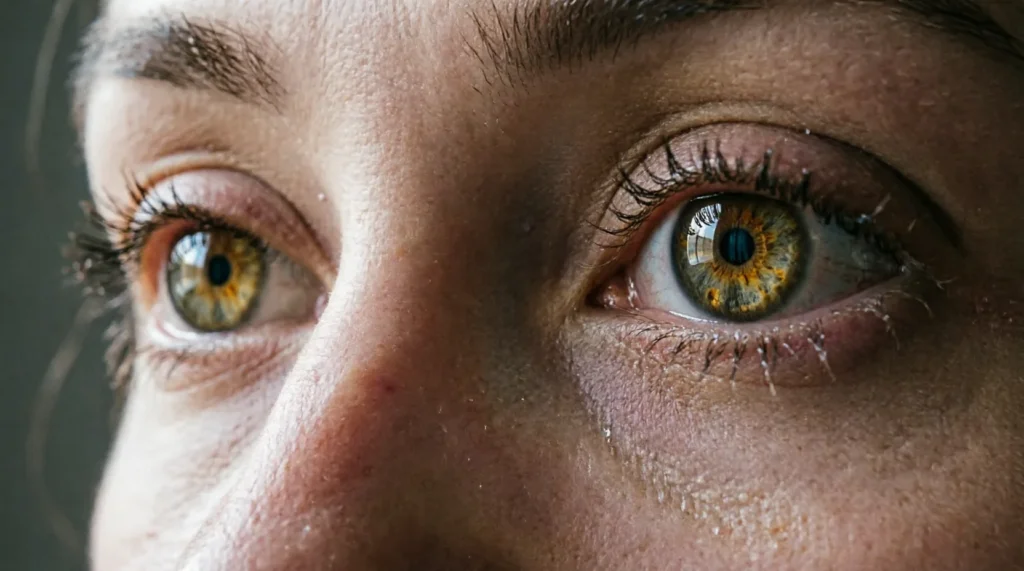
Similes to describe someone’s eyes anchor abstract emotions in tangible, sensory details. Whether you are drafting a character introduction for a novel or refining a personal essay, the right comparison instantly reveals personality, mood, and history. Use the categorized examples below to find the precise match for your character’s gaze.
Warm and Inviting Eyes
- “as warm as fresh bread” — “His eyes were as warm as fresh bread when he welcomed us into his home.” (comforting, nurturing). This comparison works because it invokes both visual warmth and the deeply ingrained, primal comfort of sustenance.
- “like sunlit honey” — “Her gaze was like sunlit honey, golden and slow to reveal its depths.” (sweet, inviting). The alliteration of “sunlit” and “honey” softens the rhythm, making the reader physically feel the warmth of the description.
- “like a hearth fire in winter” — “Looking into his eyes was like a hearth fire in winter, promising safety from the cold.” (protective, cozy).
- “as bright as a summer morning” — “She woke up with eyes as bright as a summer morning.” (optimistic, fresh).
- “like melted caramel” — “His stare was like melted caramel, rich and impossibly smooth.” (sensual, deep).
- “as gentle as a resting dove” — “Her eyes were as gentle as a resting dove, calming the room instantly.” (peaceful, non-threatening).
- “like a well-worn quilt” — “She looked at me with eyes like a well-worn quilt, familiar and deeply comforting.” (reassuring, safe).
- “as soft as morning dew” — “His apology was delivered with eyes as soft as morning dew.” (tender, sincere).
Cold and Distant Eyes
- “as cold as a winter windowpane” — “Her eyes were as cold as a winter windowpane, frosted and impenetrable.” (unyielding, detached).
- “like chips of flint” — “He looked at me with eyes like chips of flint, ready to strike a spark of anger.” (hard, dangerous). The word “flint” carries a sharp, percussive consonant sound that perfectly mirrors the sudden, physical threat in the character’s gaze.
- “as empty as an abandoned house” — “His stare was as empty as an abandoned house, echoing with nothing but drafts.” (hollow, lost).
- “like frozen lakes” — “Her eyes were like frozen lakes, beautiful but deadly if you stepped too close.” (beautiful but dangerous).
- “as sharp as shattered glass” — “He fixed me with a look as sharp as shattered glass.” (piercing, hostile).
- “like polished steel” — “The general’s eyes were like polished steel, reflecting everything but revealing nothing.” (calculating, unemotional). I always tell my students to avoid the tired cliché “cold as ice”; it lacks the specific, metallic texture and deliberate craftsmanship that “polished steel” provides.
- “like a locked vault” — “She regarded the proposal with eyes like a locked vault, guarding her true thoughts.” (secretive, guarded).
- “as blank as a fresh page” — “His eyes were as blank as a fresh page, offering no clue to his intentions.” (unreadable, neutral).
Sad and Weary Eyes
- “like rain-streaked windows” — “Her eyes were like rain-streaked windows, blurring the world outside with unshed tears.” (melancholic, obscured).
- “as heavy as wet wool” — “He lifted his lids, his eyes as heavy as wet wool after a sleepless week.” (exhausted, burdened).
- “like faded photographs” — “Her gaze was like faded photographs, holding colors that had long since washed out.” (nostalgic, diminished). This works beautifully in literary fiction because it implies a rich history that has simply lost its vibrancy over time, rather than being empty from the start.
- “as dull as tarnished silver” — “The illness left his eyes as dull as tarnished silver.” (lifeless, drained).
- “like a dying ember” — “His hope was gone, and his eyes were like a dying ember, glowing faintly before going dark.” (fading, resigned).
- “as deep as a dry well” — “She looked at me with eyes as deep as a dry well, offering no water for my questions.” (depleted, unresponsive).
- “like a wilted flower” — “After the news, her eyes were like a wilted flower, drooping under an invisible weight.” (defeated, fragile).
- “as gray as a November sky” — “He stared out the train window, his eyes as gray as a November sky.” (gloomy, hopeless).
Intense and Piercing Eyes
- “like a hawk spotting prey” — “The detective scanned the crowd with eyes like a hawk spotting prey.” (focused, predatory).
- “as bright as a welding arc” — “Her anger flashed, her eyes as bright as a welding arc, blinding and dangerous.” (intense, sudden).
- “like twin lasers” — “He cut through my excuses with eyes like twin lasers.” (analytical, unforgiving). While “twin lasers” borders on a sci-fi cliché, it works perfectly in a modern corporate thriller context where clinical, unfeeling precision is the primary threat.
- “as piercing as a winter wind” — “Her gaze was as piercing as a winter wind, cutting right through my coat.” (penetrating, uncomfortable).
- “like a magnifying glass in the sun” — “The teacher’s eyes were like a magnifying glass in the sun, burning a hole through my flimsy alibi.” (scrutinizing, exposing).
- “as unblinking as an owl’s” — “He watched the negotiation with eyes as unblinking as an owl’s, missing no detail.” (vigilant, steady).
- “like a drawn bowstring” — “Her focus was absolute, her eyes like a drawn bowstring ready to release.” (tense, anticipatory).
- “as fierce as a forest fire” — “He argued his case with eyes as fierce as a forest fire, consuming all opposition.” (passionate, unstoppable).
How to Write Your Own Eyes Simile
Writing a memorable comparison requires moving beyond generic observations. Follow these three steps to craft similes that stick with your reader.
First, identify the core emotion or physical trait you want to highlight. Is the character’s gaze tired, predatory, nurturing, or deceptive? Pinpoint the exact flavor of the emotion.
Second, anchor that trait in a specific, sensory object from the character’s world or the story’s setting. A sailor might have eyes “like frayed rope,” while a baker’s might be “like rising dough.” Grounding the comparison in the narrative environment makes it feel earned rather than pasted on.
Third, test the rhythm. Read the sentence aloud. If the comparison clunks or requires too much mental gymnastics to parse, simplify the object.
Here is a worked example. Instead of writing the generic “his eyes were sad,” identify the specific type of sadness. Let’s choose the exhaustion of a new parent.
Next, anchor that feeling in a sensory object, such as a burnt-out match. The result is a sentence with genuine weight and texture: “His eyes were like a burnt-out match, the brief flare of joy long since replaced by gray exhaustion.”
Frequently Asked Questions
What is the difference between a simile and a metaphor when describing eyes? A simile uses “like” or “as” to compare eyes to another object (e.g., “eyes like marbles”), while a metaphor states the eyes are that object (e.g., “his eyes were marbles”). According to the structural definition of a Simile, this explicit comparative phrasing makes similes particularly effective for highlighting a single, specific shared trait without fully equating the two subjects.
How do I avoid clichés when writing similes for eyes? Avoid overused comparisons like “eyes like stars” or “cold as ice.” Instead, dig into specific, unexpected nouns. When we aim to accurately Describe a character, specificity breeds originality far better than generic adjectives. Compare eyes to “tarnished silver” or “a welding arc” rather than generic gems or weather phenomena.
Can similes to describe someone’s eyes reveal character backstory? Absolutely. A single, well-chosen comparison can imply a character’s history, profession, or emotional state without explicit exposition. For example, describing a veteran’s eyes as “like a faded photograph” instantly suggests a person living in the past, carrying memories that have lost their initial vibrancy but remain permanently fixed.
Should I use multiple similes for the same character’s eyes? Use them sparingly. One powerful, well-placed simile during a character’s introduction or a pivotal emotional shift is far more impactful than stacking three or four comparisons in a single paragraph. Overloading the description dilutes the imagery, slows the pacing, and risks confusing the reader about what the character actually looks like.

Justin Brown is a seasoned literary analyst with over 15 years of experience in the field of linguistics and literary studies. Holding a master’s degree in English Literature from the University of Chicago, Justin has devoted much of his career to exploring the nuances of similes and other forms of figurative language. His passion for deciphering the layers of meaning in literary works was kindled during his undergraduate years, where he was intrigued by the power of metaphorical language. Justin frequently contributes to VividSimiles by crafting engaging articles that decode the application of similes in both classical and contemporary literature. His insightful analyses help readers grasp the beauty and complexity of figurative expressions, making literature more accessible to all. In addition to writing, Justin conducts workshops for aspiring writers, nurturing their abilities to use language vividly and effectively.