

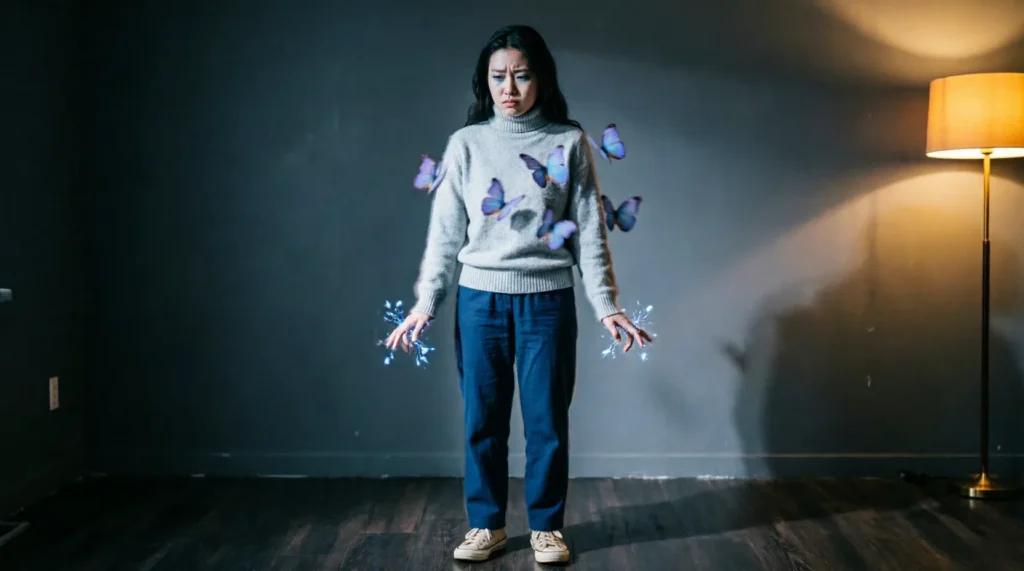
Nervousness is a physical experience before it is an emotional one. It lives in the throat, the hands, and the pit of the stomach. When you write about anxiety, generic labels like “scared” or “worried” often fail to convey the visceral reality of the moment. Using precise similes and metaphors allows your reader to feel the tremor in their own hands. The examples below are categorized by intensity and sensation, giving you immediate, ready-to-use options for your next scene.
The Physical Sensation of Nerves
Anxiety rarely stays in the mind. It manifests physically, disrupting normal bodily functions. These comparisons focus on the tangible symptoms: the shaking hands, the tight chest, and the dry mouth. I often tell my students that if they can describe the body, they don’t need to name the emotion.
- “My stomach was a knot of wet rope.” — “I stared at the phone, my stomach a knot of wet rope.” (Visceral, uncomfortable). This works because it combines tension (the knot) with a sickening texture (wet), creating a sense of dread that is hard to ignore.
- “Her hands shook like leaves in a gale.” — “She signed the document, her hands shaking like leaves in a gale.” (Classic, visual). While common, this remains effective because it conveys uncontrollable, external force acting upon a fragile object.
- “His heart hammered against his ribs like a trapped bird.” — “He waited for the verdict, his heart hammering against his ribs like a trapped bird.” (Urgent, frantic). The imagery of entrapment adds a layer of panic to the simple physical symptom of a racing heartbeat.
- “My tongue felt like a piece of dry felt.” — “I tried to speak, but my tongue felt like a piece of dry felt.” (Restrictive, awkward). This captures the specific inability to articulate words when anxiety takes over the vocal cords.
- “Sweat pricked my skin like static electricity.” — “The lights came up, and sweat pricked my skin like static electricity.” (Sharp, alert). This simile moves beyond just “being sweaty” to describe the heightened sensory awareness that accompanies nervousness.
- “My knees turned to water.” — “When he called my name, my knees turned to water.” (Weak, collapsing). A staple of creative writing, this phrase effectively communicates sudden loss of structural support due to shock or fear.
- “A cold wire tightened around my chest.” — “Reading the email, a cold wire tightened around my chest.” (Constricting, painful). This metaphor suggests a slow, mechanical constriction rather than a sudden panic, useful for describing lingering anxiety.
- “My breath came in short, sharp gasps like a broken bellows.” — “I ran up the stairs, my breath coming in short, sharp gasps like a broken bellows.” (Mechanical, failing). Comparing the lungs to a damaged tool emphasizes the inefficiency and struggle of breathing under stress.
Mental Chaos and Overthinking
Nervousness is also a cognitive event. It involves racing thoughts, inability to focus, and mental fragmentation. These similes describe the internal noise that drowns out logic. According to Wikipedia, a simile explicitly compares two different things using “like” or “as,” which is particularly useful here to bridge the gap between abstract mental states and concrete imagery.
- “My mind was a browser with too many tabs open.” — “I tried to answer, but my mind was a browser with too many tabs open.” (Modern, relatable). This resonates with contemporary readers who understand the fatigue of digital multitasking, mapping it onto mental overload.
- “Thoughts buzzed in my head like flies against a windowpane.” — “I sat in the meeting, thoughts buzzing in my head like flies against a windowpane.” (Irritating, futile). The image of insects hitting glass conveys the repetitive, trapped nature of anxious rumination.
- “My concentration shattered like dropped glass.” — “The loud noise made my concentration shatter like dropped glass.” (Sudden, irreparable). This suggests that once the focus is broken by anxiety, it cannot be easily pieced back together.
- “Worry circled my brain like a shark in shallow water.” — “As the deadline approached, worry circled my brain like a shark in shallow water.” (Predatory, imminent). This adds a sense of danger and inevitability to the feeling of being watched by one’s own fears.
- “My memory became a sieve.” — “Under pressure, my memory became a sieve, letting every fact slip through.” (Leaky, unreliable). This simple metaphor explains why we forget prepared speeches or names when nervous.
- “Ideas collided in my head like bumper cars.” — “During the brainstorm, ideas collided in my head like bumper cars.” (Chaotic, directionless). This captures the lack of linear progression in anxious thinking, where thoughts bounce off each other without moving forward.
- “My focus frayed like an old rope.” — “By the third hour, my focus frayed like an old rope.” (Gradual, weakening). This implies a slow degradation of mental strength rather than a sudden break, suitable for long periods of stress.
Social Anxiety and Performance Pressure
Public speaking, first dates, and job interviews trigger a specific type of nervousness rooted in judgment. These similes focus on the feeling of exposure, vulnerability, and the desire to disappear. In my workshops, I encourage writers to avoid clichés like “butterflies in the stomach” for these high-stakes moments, as they often minimize the genuine terror involved.
- “I felt as exposed as a snail without its shell.” — “Walking onto the stage, I felt as exposed as a snail without its shell.” (Vulnerable, soft). This highlights the removal of protective barriers, leaving the character sensitive to every critique.
- “All eyes were spotlights burning my skin.” — “In the silence, all eyes were spotlights burning my skin.” (Intense, painful). This metaphor transforms the gaze of others into a physical threat, emphasizing the heat and discomfort of being watched.
- “My voice sounded thin and reedy, like a radio losing signal.” — “I introduced myself, my voice sounding thin and reedy, like a radio losing signal.” (Unstable, fading). This auditory simile captures the lack of authority and presence that often accompanies social nervousness.
- “I wanted to fold myself into the wallpaper.” — “After the mistake, I wanted to fold myself into the wallpaper.” (Desperate, shrinking). This hyperbole expresses the intense desire for invisibility and escape from social scrutiny.
- “Silence stretched between us like a tightrope.” — “We waited for the elevator, silence stretching between us like a tightrope.” (Tense, precarious). This suggests that any movement or word could cause a catastrophic fall, highlighting the fragility of social interaction.
- “My smile felt glued on, stiff and artificial.” — “Greeting the boss, my smile felt glued on, stiff and artificial.” (Forced, unnatural). This describes the disconnection between internal feeling and external performance, a key aspect of social anxiety.
- “I stood there like a deer in headlights, frozen by expectation.” — “When asked for my opinion, I stood there like a deer in headlights, frozen by expectation.” (Paralyzed, stunned). While common, this remains a powerful shorthand for total cognitive shutdown in social situations.
Metaphors for Deep-Seated Dread
Sometimes nervousness is not a fleeting moment but a pervasive atmosphere. These metaphors describe anxiety as a weight, a weather system, or a living entity. They are best used for literary fiction or deep character studies where the emotion is central to the narrative. As noted in discussions of Metaphor, these implicit comparisons allow for deeper thematic resonance by equating the emotion with larger, more permanent forces.
- “Anxiety was a heavy coat I couldn’t take off.” — “Even on vacation, anxiety was a heavy coat I couldn’t take off.” (Burdenome, constant). This metaphor emphasizes the inescapable nature of chronic nervousness, regardless of external circumstances.
- “Dread pooled in my belly like cold mercury.” — “Waiting for the test results, dread pooled in my belly like cold mercury.” (Toxic, heavy). Mercury is dense and poisonous, suggesting that the fear is not just uncomfortable but harmful to the character’s well-being.
- “Fear was a tenant who refused to pay rent.” — “Living alone, fear was a tenant who refused to pay rent.” (Intrusive, persistent). This personifies anxiety as an unwanted guest that occupies space and resources without contributing anything positive.
- “The worry was a low hum in the background of my life.” — “Throughout the year, the worry was a low hum in the background of my life.” (Constant, subtle). This auditory metaphor describes anxiety that is always present but not always dominant, like tinnitus or distant traffic.
- “Panic rose in me like floodwater behind a dam.” — “Seeing the error, panic rose in me like floodwater behind a dam.” (Building, explosive). This captures the potential energy of suppressed anxiety, suggesting that a breach is inevitable and catastrophic.
- “My nerves were live wires sparking in the dark.” — “Insomnia left my nerves as live wires sparking in the dark.” (Dangerous, volatile). This implies that the character is dangerous to themselves and others, ready to short-circuit at any touch.
How to Write Your Own Nervous Simile
Creating original comparisons requires observing the specific physical or mental effect of the nervousness in your scene. Do not start with the word “nervous.” Start with the symptom.
- Identify the specific sensation. Is it shaking? Heat? Silence? Heaviness? For example, if your character feels heavy, do not just say “heavy.” Ask what kind of heavy. Is it the heaviness of wet wool? Of lead? Of a sinking stone?
- Find a concrete object with that quality. Look for objects in the character’s immediate environment or their profession. A carpenter might feel “stiff as untreated lumber.” A musician might feel “out of tune like a warped string.”
- Connect them with “like” or “as.” Ensure the comparison adds emotional weight. Avoid mixed metaphors.
Worked Example:
- Symptom: Inability to move.
- Object: Rusty hinge.
- Simile: “My joints moved like rusty hinges, grinding with every step toward the podium.”
This works because it connects the physical stiffness with the sound of resistance, adding an auditory layer to the visual.
Frequently Asked Questions
What is the difference between a simile and a metaphor for nervousness? A simile uses “like” or “as” to compare nervousness to something else (e.g., “shaking like a leaf”), while a metaphor states that nervousness is that thing (e.g., “anxiety was a cage”). Similes are often clearer for quick descriptions, while metaphors can create deeper, more immersive atmospheric effects.
How do I avoid clichés when writing about anxiety? Avoid overused phrases like “butterflies in the stomach” or “nervous wreck.” Instead, focus on unique, specific details relevant to your character. If your character is a chef, describe their nerves as “curdled milk.” If they are a runner, describe their heart as “a piston misfiring.” Specificity kills clichés.
Can nervousness be described positively? Yes. Nervous energy can be framed as excitement or readiness. Similes like “buzzing like a live wire” or “vibrating like a plucked string” can convey high energy and anticipation rather than just fear. Context determines whether the sensation is interpreted as positive or negative.
Why are physical similes more effective than emotional labels? Physical similes engage the reader’s sensory experience. Saying “he was nervous” tells the reader what to think. Saying “his hands were cold blocks of ice” makes the reader feel the coldness. This “show, don’t tell” approach creates empathy and immersion, allowing the reader to experience the character’s state rather than just observing it.

Justin Brown is a seasoned literary analyst with over 15 years of experience in the field of linguistics and literary studies. Holding a master’s degree in English Literature from the University of Chicago, Justin has devoted much of his career to exploring the nuances of similes and other forms of figurative language. His passion for deciphering the layers of meaning in literary works was kindled during his undergraduate years, where he was intrigued by the power of metaphorical language. Justin frequently contributes to VividSimiles by crafting engaging articles that decode the application of similes in both classical and contemporary literature. His insightful analyses help readers grasp the beauty and complexity of figurative expressions, making literature more accessible to all. In addition to writing, Justin conducts workshops for aspiring writers, nurturing their abilities to use language vividly and effectively.