

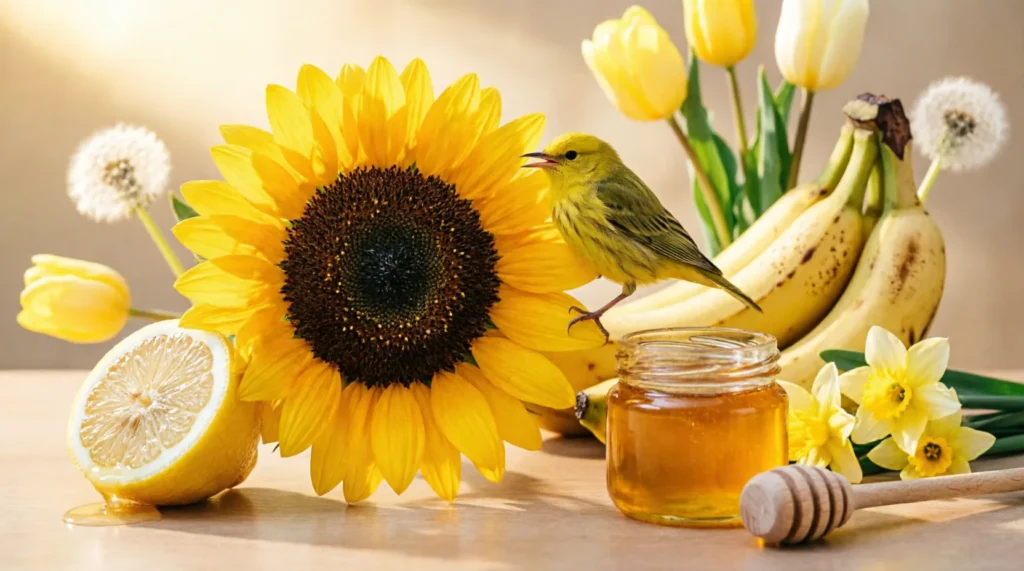
Similes for the color yellow help writers capture everything from the warmth of summer sunshine to the sharp tang of citrus. Whether you’re describing a golden sunset, a sickly pallor, or the bright optimism of spring flowers, the right comparison transforms a simple color into a sensory experience. Below you’ll find categorized similes with real example sentences so you can drop them directly into your poetry, fiction, or descriptive essays.
Bright and Cheerful Yellows
These similes capture yellow at its most vibrant and uplifting—the kind that makes people squint and smile. Use these when you want to convey energy, optimism, or pure joy.
“bright as sunshine” — “Her dress was bright as sunshine against the gray November sky.” (uplifting, warm) Craft note: This works because “sunshine” carries emotional weight beyond just light—it triggers memories of good days.
“yellow as a canary” — “The kitchen walls were painted yellow as a canary, impossible to ignore.” (bold, cheerful)
“like daffodils after rain” — “Her smile appeared like daffodils after rain, sudden and refreshing.” (fresh, hopeful) Craft note: The “after rain” addition creates a before/after contrast that makes the yellow feel earned, not just decorative.
“yellow as a school bus” — “The taxi was yellow as a school bus, announcing itself blocks away.” (practical, attention-grabbing)
“like a field of sunflowers” — “The meadow stretched out like a field of sunflowers, all facing the same direction.” (abundant, unified)
“yellow as a highlighter” — “Her notes were marked yellow as a highlighter, impossible to miss during exam prep.” (modern, functional)
“bright as a warning sign” — “The caution tape was bright as a warning sign, keeping everyone back.” (urgent, alarming)
“like buttercups in grass” — “Tiny flowers dotted the lawn like buttercups in grass, easy to overlook but lovely when noticed.” (delicate, natural)
Skip “yellow as a banana”—it’s the first comparison everyone reaches for, which makes it feel lazy. Your reader’s brain fills in “banana” before you finish the sentence, robbing your description of surprise.
Rich and Warm Yellows
These similes describe yellows with depth, luxury, or comfort. Think golden hour photography, aged parchment, or the glow of candlelight. These work beautifully in romantic or nostalgic scenes.
“yellow as liquid gold” — “The honey poured from the spoon, yellow as liquid gold.” (luxurious, valuable) Craft note: “Liquid” adds movement to what could be a static comparison, making the reader visualize the flow.
“like aged parchment” — “The letter had turned like aged parchment, fragile at the edges.” (antique, delicate)
“yellow as amber” — “Her eyes were yellow as amber, catching the light from within.” (precious, translucent)
“like melted butter” — “The sauce was yellow like melted butter, rich and indulgent.” (comforting, smooth)
“yellow as old photographs” — “The memories faded yellow as old photographs, softer at the edges.” (nostalgic, bittersweet)
“like candlelight on skin” — “The evening glow made everything look like candlelight on skin, warmer than reality.” (intimate, romantic)
“yellow as saffron threads” — “The rice was yellow as saffron threads, worth the expensive spice.” (exotic, refined)
“like wheat at harvest” — “The fields stretched yellow like wheat at harvest, ready and abundant.” (ripe, seasonal) Craft note: “At harvest” specifies a moment in time, creating urgency. Wheat could be green or golden—this pins it down.
According to Wikipedia’s entry on Yellow, the color has historically been associated with gold and wealth across cultures, which is why these rich comparisons feel instinctively valuable to readers.
Sharp and Tart Yellows
Not all yellows are warm and welcoming. Some are acidic, aggressive, or unpleasant. These similes work when you’re describing something harsh, warning-colored, or deliberately off-putting.
“yellow as a lemon rind” — “The paint was yellow as a lemon rind, sharp enough to make you pucker.” (acidic, intense)
“like sulfur smoke” — “The fog rolled in like sulfur smoke, yellow and choking.” (toxic, dangerous)
“yellow as mustard stain” — “His shirt had a spot yellow as mustard stain, embarrassing and obvious.” (messy, careless)
“like battery acid” — “The chemical was yellow like battery acid, clearly labeled and locked away.” (hazardous, industrial)
“yellow as a caution light” — “The signal blinked yellow as a caution light, telling him to slow down.” (hesitant, transitional)
“like old urine” — “The carpet was yellow like old urine, impossible to clean.” (disgusting, neglected)
“yellow as a wasp’s stripe” — “The jacket was yellow as a wasp’s stripe, daring you to get closer.” (aggressive, warning) Craft note: This works because wasps carry an implicit threat—the yellow isn’t just color, it’s a signal to back off.
“like jaundiced skin” — “His complexion had turned like jaundiced skin, worrying the doctors.” (sickly, medical)
Avoid “yellow as a coward” unless you’re deliberately invoking the outdated “yellow-bellied” stereotype. It’s a cultural cliché that reduces the color to a single negative trait, and modern readers often find it tired.
Natural and Earthy Yellows
These similes ground yellow in the organic world—harvests, wildlife, and unprocessed materials. They’re perfect for nature writing, rural settings, or descriptions that need to feel authentic rather than polished.
“yellow as corn silk” — “The fabric was yellow as corn silk, soft and naturally dyed.” (organic, gentle)
“like an egg yolk” — “The center was yellow like an egg yolk, runny and rich.” (food-related, visceral)
“yellow as a dandelion clock” — “The flower was yellow as a dandelion clock, waiting to scatter.” (childlike, fleeting)
“like beeswax candles” — “The wood had a finish like beeswax candles, hand-rubbed and warm.” (artisanal, natural)
“yellow as ripe peaches” — “The sunset turned the clouds yellow as ripe peaches, almost edible.” (juicy, summer)
“like a lion’s mane” — “His hair was yellow like a lion’s mane, wild and untamed.” (powerful, animal)
“yellow as autumn leaves” — “The path was covered yellow as autumn leaves, crisp underfoot.” (seasonal, transitional) Craft note: Autumn leaves aren’t purely yellow—they’re a mix. This simile works because it captures a moment of change, not a fixed state.
“like flax fields” — “The countryside stretched like flax fields, pale and windswept.” (rural, European)
These comparisons feel grounded because they reference things readers have likely touched, tasted, or seen in real life. That tactile quality makes descriptions stick.
Faded and Unpleasant Yellows
Sometimes yellow signals age, illness, or decay. These similes help you describe things that have lost their vibrancy or were never vibrant to begin with.
“yellow as old newspaper” — “The pages had turned yellow as old newspaper, crumbling at the touch.” (aged, fragile)
“like nicotine stains” — “His fingers were yellow like nicotine stains, telling a story he wouldn’t admit.” (habit-formed, shameful)
“yellow as moldy bread” — “The cheese had gone yellow as moldy bread, better thrown away.” (spoiled, wasteful)
“like tarnished brass” — “The fixtures were yellow like tarnished brass, neglected for years.” (oxidized, forgotten)
“yellow as a fading bruise” — “The mark on her arm was yellow as a fading bruise, almost healed.” (healing, temporary)
“like old ivory” — “The keys were yellow like old ivory, discolored by decades of touch.” (antique, used)
“yellow as weak tea” — “The liquid was yellow as weak tea, diluted and disappointing.” (pale, insubstantial)
“like a sick moon” — “The sky glowed like a sick moon, yellow and wrong.” (unnatural, ominous) Craft note: Adding “sick” to “moon” subverts the usual romantic lunar imagery. It creates unease because it violates expectation.
How to Write Your Own Yellow Simile
Creating original similes for yellow requires you to think beyond the obvious. Here’s my three-step process that I teach in every workshop:
Step 1: Identify the specific shade and context. Is this yellow bright or muted? Warm or cool? Natural or artificial? “Yellow as sunshine” could describe a dress, a room, or a mood—each needs different specifics.
Step 2: Pull from sensory memory, not color charts. Don’t just think “what’s yellow?” Think “what does this yellow feel like?” Does it taste like lemon? Smell like hay? Sound like a trumpet? The best similes cross sensory boundaries.
Step 3: Add a detail that creates tension or surprise. Instead of “yellow as gold,” try “yellow as stolen gold.” Instead of “yellow as a flower,” try “yellow as a flower forced indoors.” The extra detail does the heavy lifting.
Worked example: Let’s say you’re describing a character’s nervous smile.
Weak: “Her smile was yellow.” (This isn’t even a simile, and it’s confusing.)
Better: “Her smile was yellow as sunshine.” (Generic, doesn’t match the nervous context.)
Strong: “Her smile was yellow as a warning flag, brave but clearly signaling danger.” (Now the yellow serves the emotion—it’s not just descriptive, it’s functional.)
Frequently Asked Questions
What makes a good yellow simile different from just naming a yellow object?
A strong simile creates an emotional or sensory connection beyond color. Saying “yellow as a lemon” just names an object. Saying “yellow as a lemon dropped in tea” adds action, transformation, and the specific moment when yellow spreads through clear liquid. The second version gives your reader something to visualize, not just categorize.
Can yellow similes work for non-visual descriptions?
Absolutely. I use yellow similes for moods, sounds, and even time periods. “The afternoon stretched yellow as old honey” describes both color and the slow, sticky quality of time. “His laugh was yellow as a trumpet blast” connects color to sound. The key is finding what the yellow does, not just what it looks like.
Are there yellow similes appropriate for formal academic writing?
Yes, but choose carefully. “Yellow as aged parchment” or “yellow as wheat at harvest” work in literary analysis or historical writing because they reference culturally significant materials. Avoid food comparisons or anything too folksy. According to Wikipedia’s entry on Simile, effective similes in formal writing illuminate rather than decorate—they should clarify your point, not just add flourish.
How do I avoid clichés when writing about yellow?
Test your simile by asking: “Have I read this exact comparison in the last month?” If yes, push further. Instead of “yellow as the sun,” try “yellow as the sun reflected in a car window”—it’s still sunshine, but specific and unexpected. The version my students always reach for first is “yellow as gold,” but I push them to specify what kind of gold: jewelry, coins, light, or something tarnished. Specificity kills clichés.

Brian Walker is an esteemed linguist with a Ph.D. in Language and Literature from Stanford University. Over the past 20 years, Brian has dedicated his research to understanding the impact of figurative language on communication and literature. His extensive body of work includes scholarly articles that have been published in numerous academic journals. Brian’s fascination with similes emerged during his doctoral studies, where he examined their role in enhancing rhetorical persuasion and emotional resonance. As a contributor to VividSimiles, he writes detailed analyses on the historical evolution of similes and their varied applications across different cultures and languages. Brian’s articles are known for their depth and clarity, bridging the gap between academic research and practical application. He is committed to enlightening readers about the intricacies of language and the beauty of well-crafted similes.